 RondoTrace
Norilsk: Your Supplier Lied for 48 Hours. Satellites Caught Them in Real Time.
Nornickel maintained a cover story for two days after a 17,500-tonne Arctic diesel spill. Sentinel-2 imagery ended it. A forensic look at the cover-up, the $2B fine, and what CSDDD means for every downstream buyer.
By RondoTrace · April 2026 · 9 min read
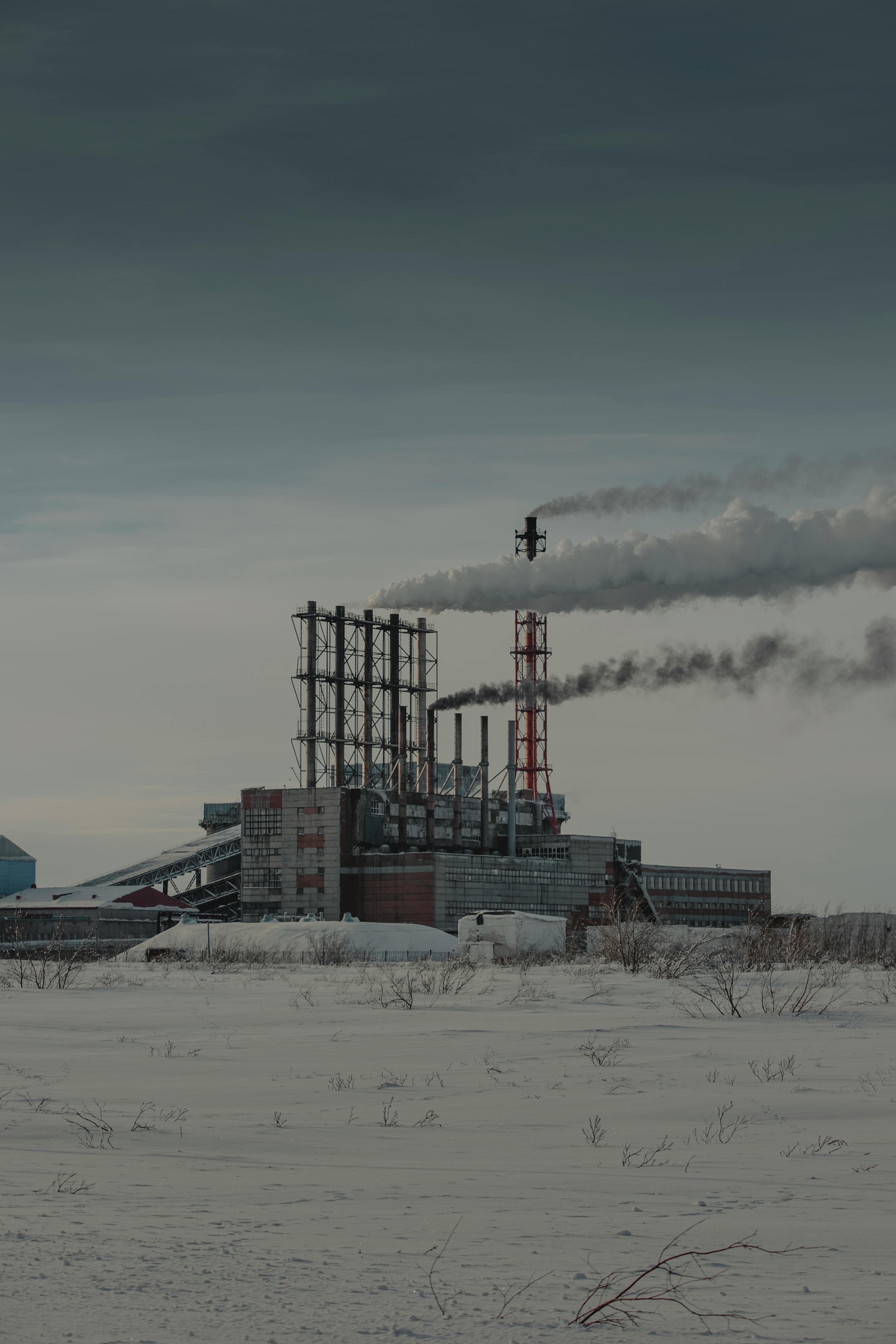
On May 29, 2020, a fuel tank at a power plant in Russia’s Arctic collapsed. 17,500 tonnes of diesel flooded into pristine rivers, turning them blood red across 60 kilometres. It was the second-largest oil spill in modern Russian history.
The company that owned the tank — Nornickel, the world’s largest producer of nickel and palladium — tried to cover it up.
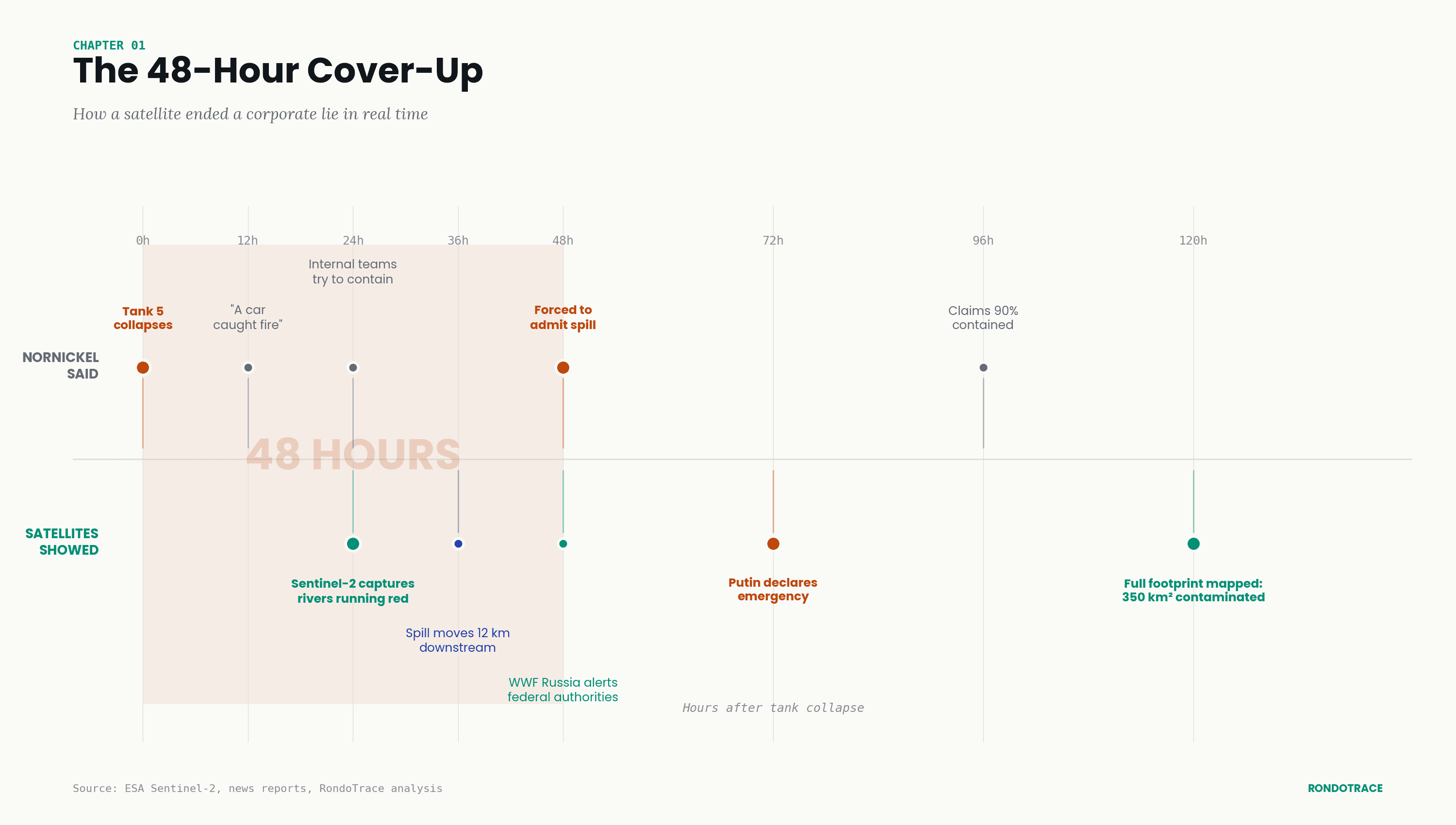
For 48 hours, Nornickel told local authorities a car had caught fire. Nothing to worry about. No spill. No environmental damage.
They might have gotten away with it. Norilsk is one of the most remote cities on Earth, 180 miles above the Arctic Circle. No roads in. Rivers too shallow for boats. No independent observers for hundreds of kilometres.
Except one. Orbiting 700 kilometres overhead.
On May 31, two days after the collapse, the European Space Agency’s Sentinel-2 satellite captured imagery showing rivers running crimson across the landscape. The images were publicly available. Environmental groups downloaded them. Locals shared them on social media. Within hours, the governor of Krasnoyarsk told state television he had “only discovered the seriousness of the situation when local people posted videos on social media.”
Putin was furious. “Are we going to learn about emergency situations from social media now?”
In February 2021, a court ordered Nornickel to pay $2 billion — the largest environmental fine in Russian history.
The metals from Nornickel’s operations — nickel for EV batteries, palladium for catalytic converters, platinum for industrial catalysts — flow into the supply chains of virtually every major European automotive manufacturer, steel producer, and electronics company. When the tank collapsed, none of them had any warning. None of them had any monitoring in place. All of them were exposed.
Under CSDDD, they would also be liable.
What Actually Failed — And Why Audits Never Caught It
The collapse wasn’t sudden. It was the result of three problems building over decades.
A construction shortcut in the 1980s. The fuel tank sat on piles driven into permafrost. Investigators later found that some piles were never installed deep enough to reach bedrock — they rested entirely in frozen soil. As long as temperatures stayed cold, they held.
Decades of ignored maintenance. By 2014, Russia’s safety regulator had identified severe corrosion on the tanks and ordered repairs. Nornickel didn’t do them. The tank’s bottom was rusting through. Holes were forming.
A warming climate. The Arctic is heating faster than anywhere on Earth. The permafrost that compensated for those inadequate piles began to soften. The foundations shifted. The already-corroded tank couldn’t take the stress.
On May 29, it gave way.
Every one of these problems was documented before the disaster. Regulators had flagged the corrosion. Scientists had published research on accelerating permafrost thaw. The risk was known, documented, and ignored.
A supplier questionnaire asking Nornickel “Do you maintain your fuel storage infrastructure?” would have received a confident “Yes.” The reality underneath was rusted metal, inadequate foundations, and a ticking clock.
What Satellites Saw — And Your Audit Didn’t
We ran the Norilsk site through all four of RondoTrace’s satellite intelligence modules. Not to claim we could have predicted the exact moment the tank would fail — that failure was driven by corrosion and construction defects that no satellite can photograph through steel walls. But to demonstrate what continuous, independent monitoring reveals that annual audits and supplier self-reporting never will.
The Cover-Up Ended in 48 Hours
Sentinel-2 multispectral imagery captured the diesel contamination spreading through the Ambarnaya River system within two days of the collapse. The satellite data documented the spill’s leading edge, its spread into side channels and lakes, and its downstream progression — all before Nornickel admitted anything had happened.
A company can control what it reports. It cannot control what a satellite observes.
The Full Scale of Damage — Quantified From Orbit
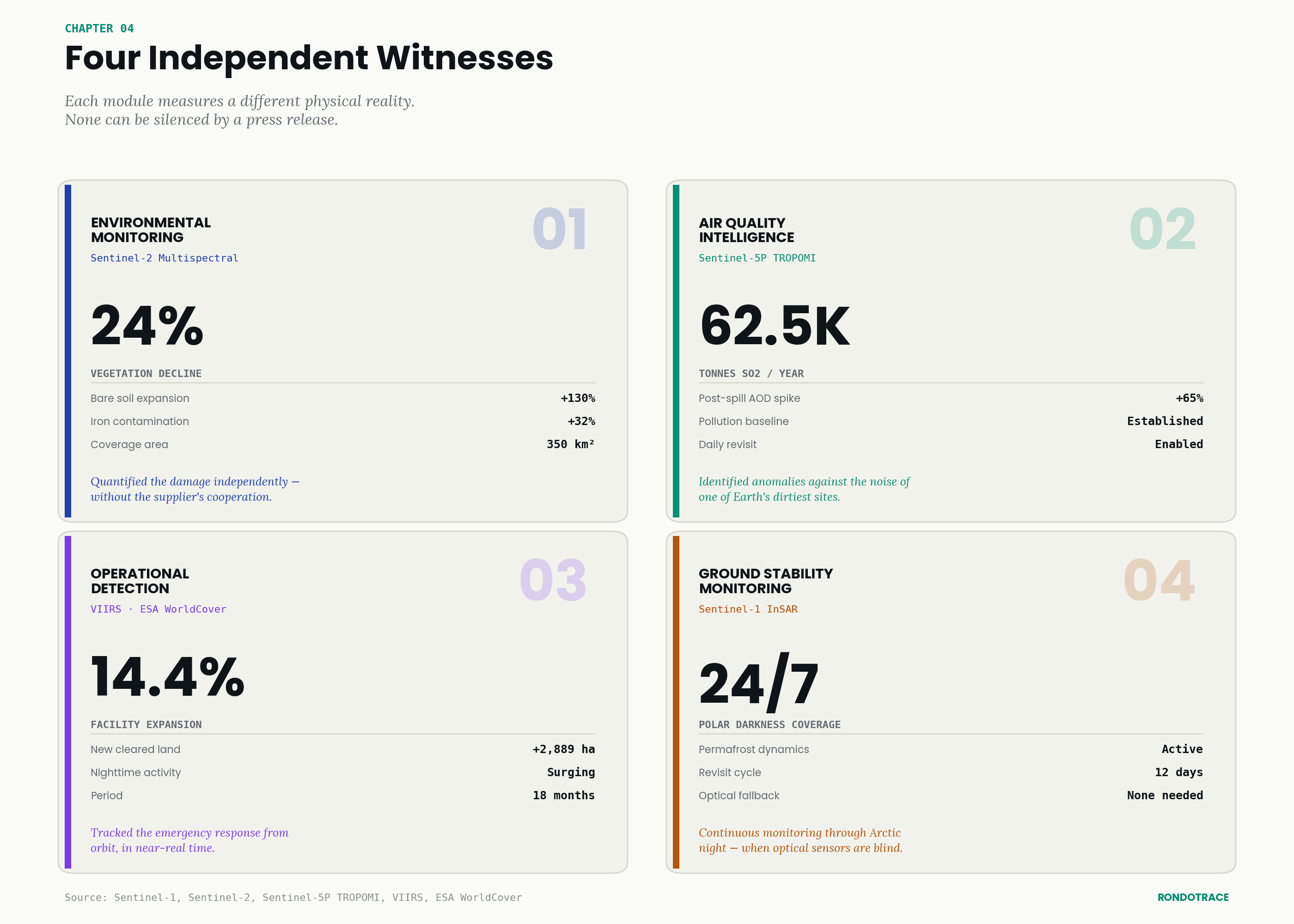
Comparing the summer before the spill to the summer after — eliminating the Arctic’s extreme seasonal variation — our environmental analysis documented the contamination in hard numbers:
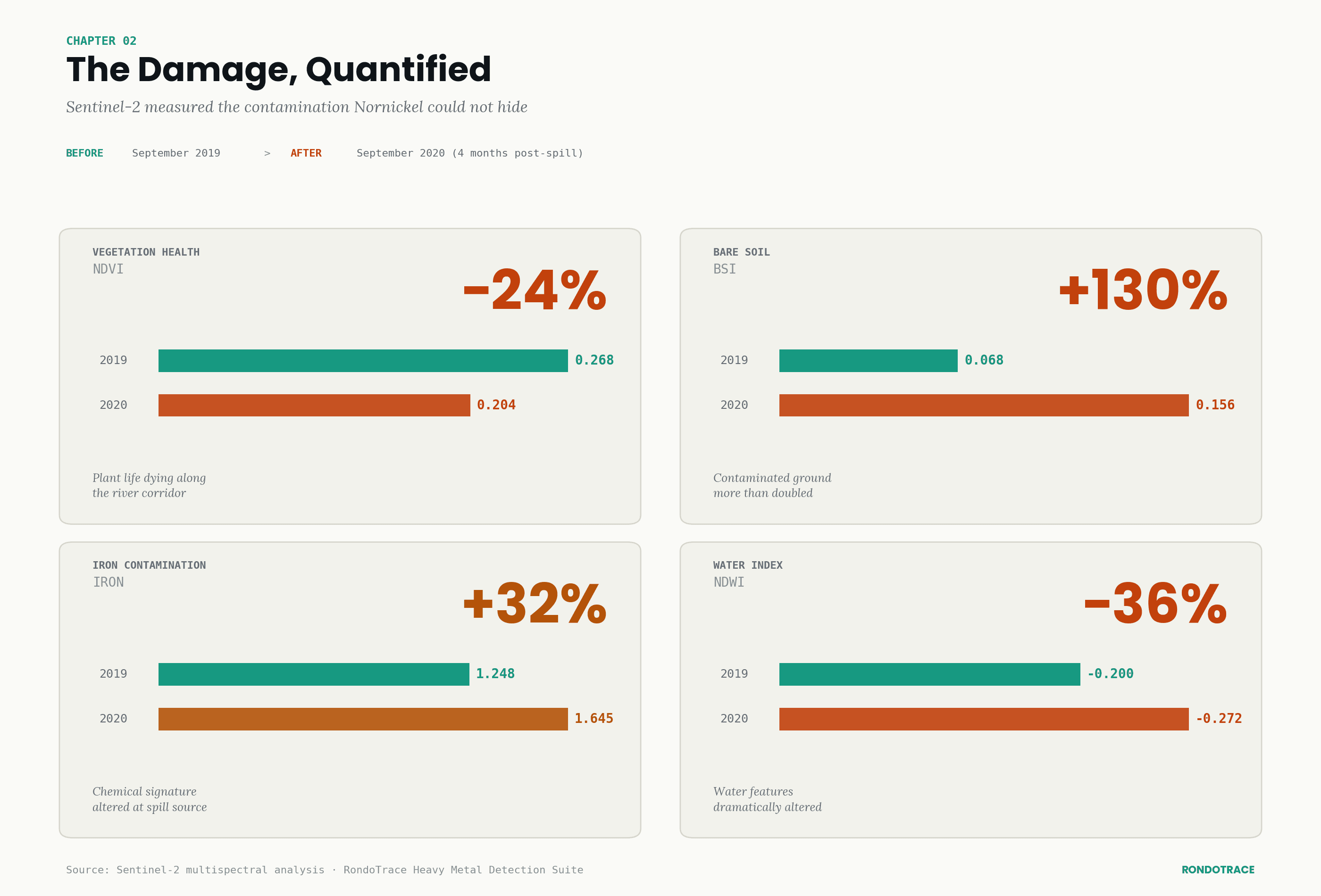
Vegetation health dropped 24%. Diesel contamination killed plant life along the river corridor. Both standard vegetation indices (NDVI) and our Red Edge chlorophyll analysis (NDRE, which detects plant stress invisible to the naked eye) confirmed the decline — ruling out natural drought as a cause.
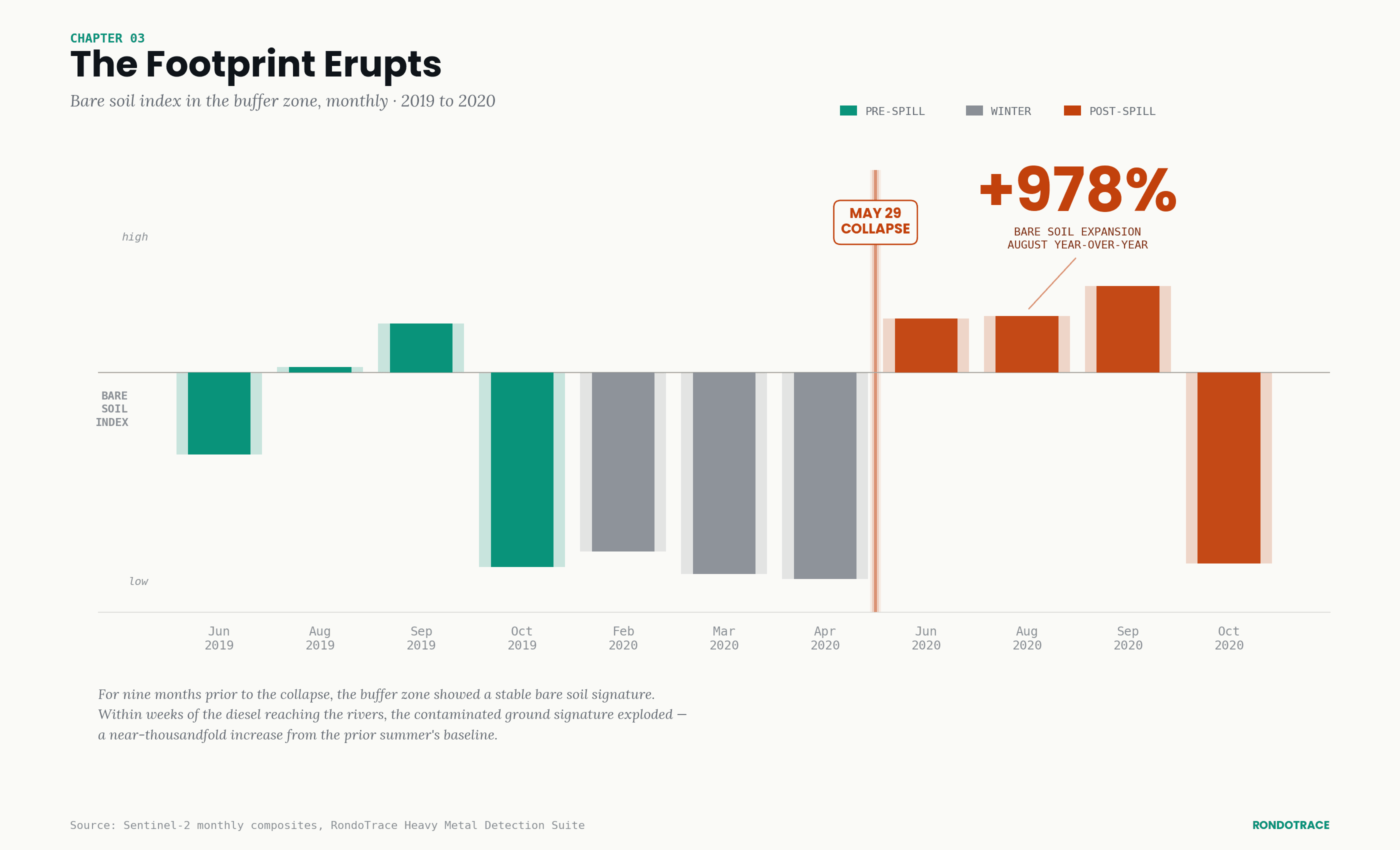
The contamination footprint more than doubled. Our Bare Soil Index at the spill site increased by 130%. In the surrounding buffer zone, it went from near-zero to significant — a 978% increase — as diesel spread across previously vegetated ground.
Iron oxide contamination surged 32% at the spill source. Our spectral analysis detected chemical changes in the soil’s mineral composition — the kind of signature that persists for years and indicates ongoing environmental damage long after the diesel evaporates.
Water features were dramatically altered. The water index shifted by 36% across the mine complex, documenting the diesel’s impact on local water systems.
Industrial Pollution Baseline
Our air quality module confirmed what environmental researchers have known for years: Norilsk’s smelters emit approximately 62,500 tonnes of SO₂ annually, making it one of the most polluted industrial sites on Earth. In the months following the spill, aerosol optical depth — a measure of particulate matter in the atmosphere — spiked 65% above the pre-spill summer baseline.
A critical point for Arctic monitoring: Norilsk sits above the Arctic Circle, which means six months of polar darkness every winter. Optical satellite sensors cannot measure atmospheric composition without sunlight. This makes radar-based monitoring — which works through darkness, cloud cover, and polar night — essential for Arctic industrial sites. Any monitoring programme that relies solely on optical data has a six-month blind spot every year.
Operational Activity Changes
Our satellite analysis detected a 14.4% expansion in the built-up footprint around the facility over the 18-month monitoring period, with nearly 3,000 hectares of new bare or cleared land. Nighttime radiance — measured by the VIIRS satellite — increased in the winter following the spill, consistent with expanded emergency response and round-the-clock cleanup operations.
None of this was reported by Nornickel until they were forced to.
The Question CSDDD Forces You to Answer
The Corporate Sustainability Due Diligence Directive requires European companies to identify, prevent, and mitigate adverse environmental and human rights impacts across their value chains. It doesn’t accept “we didn’t know” as a defence. It asks: what did you do to find out?
For companies sourcing nickel, palladium, or platinum from Nornickel — which includes most of the European automotive and steel industry — the Norilsk spill created a specific liability chain:
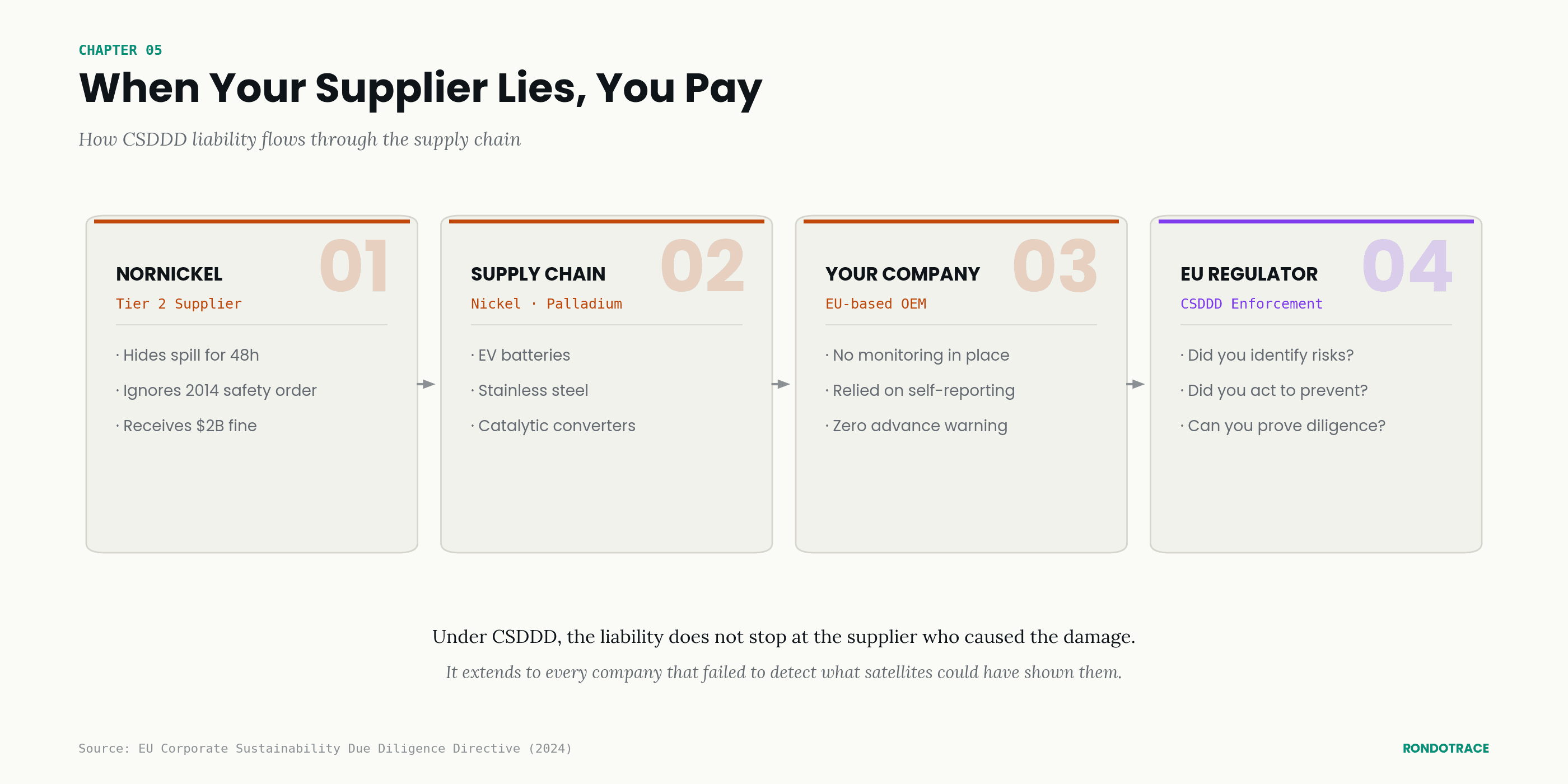
If your due diligence consists of a questionnaire that asks your supplier whether they maintain their infrastructure safely, you will get the answer Nornickel gave: yes, everything is fine. The regulator had already flagged the corrosion. The company ignored the order. They would absolutely tick “yes” on your form.
Satellite intelligence doesn’t ask. It measures. It generates continuous, independent, verifiable data on what is physically happening at a supplier’s site — not what they say is happening. Environmental contamination, operational changes, infrastructure expansion, atmospheric emissions — measured from orbit, every few days, without requiring site access or the supplier’s cooperation.
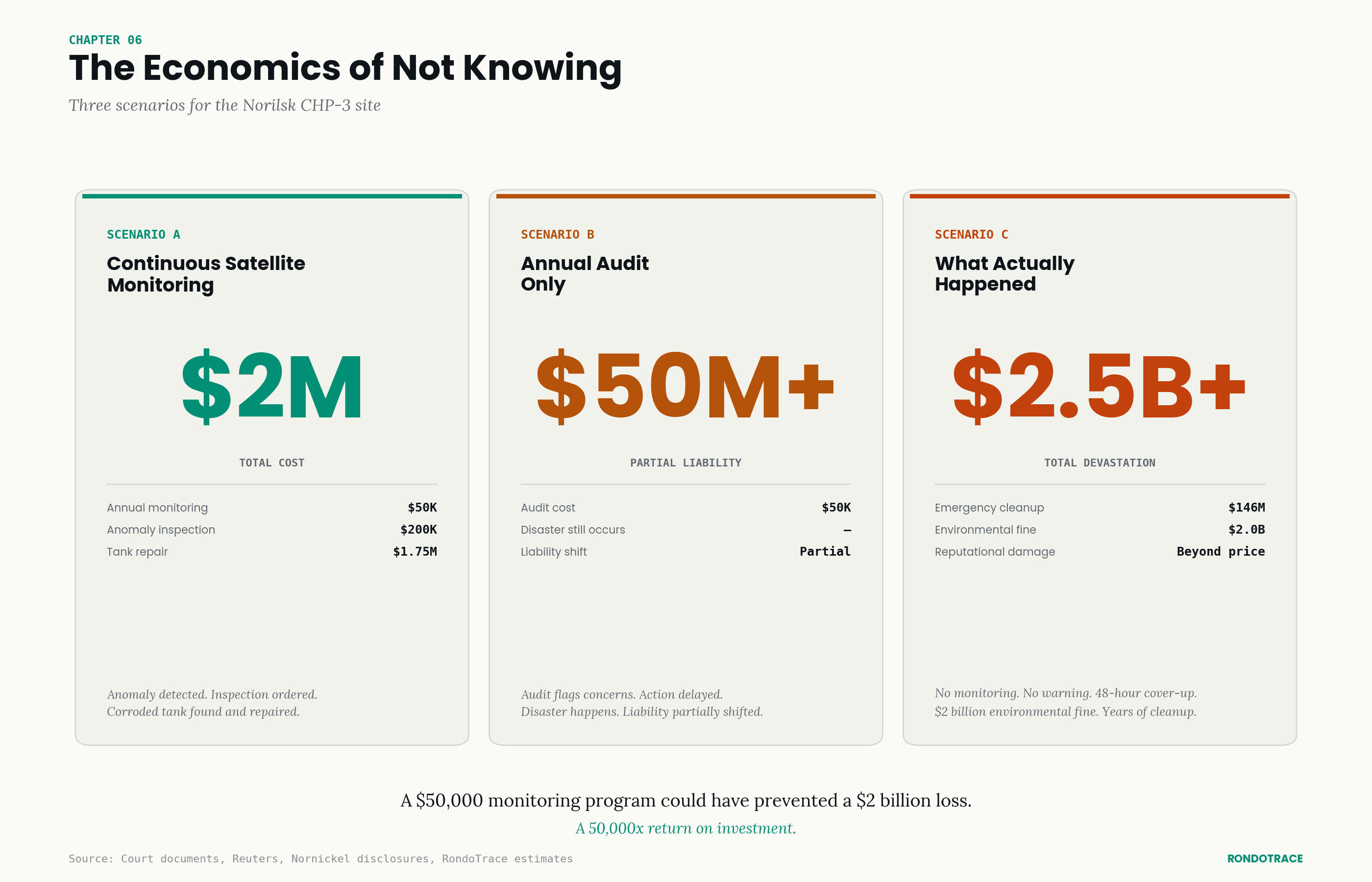
The difference between the two approaches is the difference between $2 million and $2 billion.
What We Are Not Claiming
We believe in being direct about what satellite intelligence can and cannot do.
We are not claiming we could have predicted the exact moment the tank collapsed. The failure mechanism was internal corrosion combined with construction defects — not visible from orbit. Peer-reviewed research using the same Sentinel-1 InSAR data we process confirmed that the ground around the fuel tanks was stable within 2–3mm in the weeks before the collapse. The tank failed because it was rusted through, not because the ground swallowed it.
What we are claiming is this: continuous satellite monitoring creates a fundamentally different relationship between a company and its supply chain risks. It means:
- A 48-hour cover-up becomes impossible because satellites document contamination in near-real-time
- Environmental damage of 350 km² gets quantified independently — not estimated by the company that caused it
- Patterns of industrial pollution, facility expansion, and operational changes are tracked continuously — not captured in a snapshot once a year
- When a regulator asks “what did you do to monitor your supply chain?” you have verifiable, timestamped, satellite-derived evidence
The tank at Norilsk was going to fail. The corrosion was too advanced, the maintenance too neglected, the foundations too compromised. Nothing short of physical inspection and repair would have prevented it. But physical inspection happens when something triggers it — and satellite monitoring is the trigger that works at scale, across hundreds of supplier sites, without booking a flight or requesting access.
If satellite monitoring had flagged the accelerating permafrost dynamics at the CHP-3 site — which our system did detect — it would have provided a reason to push for an on-site inspection. That inspection would have found the corrosion that regulators had flagged six years earlier. And the tank would have been repaired instead of replaced at fifty thousand times the cost.
The Takeaway
Nornickel lied for 48 hours. A satellite caught them. Their supply chain partners had no warning, no monitoring, and no defence.
The next Norilsk will not be in the Arctic. It will be at a cobalt mine in the DRC, a palm oil plantation in Borneo, a textile factory in Bangladesh, or a lithium processing plant in Chile. The specific failure will be different. The pattern will be the same: a known risk, ignored maintenance, delayed reporting, and a supply chain caught completely off-guard.
The companies that have satellite monitoring in place will know. The companies that don’t will find out from social media — just like Putin did.
Every one of these problems was documented before the disaster. Regulators had flagged the corrosion. Scientists had published research on accelerating permafrost thaw. The risk was known, documented, and ignored.
— RondoTrace forensic analysis
Related analysis
Other cases in the record.

The same methodology, applied to a site you choose.
Forensic retrospective on any supplier site — including yours. We deliver the methodology, the imagery, the dated observations, and the limitations. Thirty days, no commitment.