 RondoTrace
How We Estimate the Scope 1, 2, and 3 Emissions of Any Supplier Site, From Space
A walkthrough of the methodology that produces auditable carbon numbers for your supplier portfolio — without supplier cooperation, and without waiting for the next disclosure cycle.
By RondoTrace · 30 April 2026 · 11 min read

If you run ESG or sustainability at an industrial OEM today, you have a problem you are probably tired of explaining to your board.
CSRD requires you to report Scope 1, 2, and 3 emissions across your value chain. CBAM is now demanding verified Scope 1 and 2 numbers from your steel, aluminium, cement, fertiliser, and hydrogen suppliers — with financial penalties for getting it wrong. Your auditors want a defensible methodology behind every number you publish. Your supply chain spans hundreds, sometimes thousands, of supplier sites across dozens of countries.
And the data you currently rely on is, to put it plainly, not good enough.
Some of your suppliers report. Most of those report annually, six to eighteen months in arrears, using methodologies you cannot verify. Many of your suppliers do not report at all — they are not in CDP, they are not in EU ETS, they are not subject to BRSR, and they have no commercial incentive to give you their carbon numbers. You fill the gaps with industry-average emission factors and hope nobody examines the margin of error.
This article walks through how RondoTrace produces Scope 1, 2, and 3 emissions estimates for any industrial site on Earth, refreshed monthly, with full data lineage, using satellite observations and our proprietary AI model. No supplier cooperation required. No annual reporting cycle to wait for. No black box.
What changed: the gap between supplier disclosure and physical reality
Carbon accounting was designed in an era when the only way to know what a facility emitted was to ask it. Self-reported activity data, multiplied by published emission factors, audited every few years. That era is ending.
It is ending because the European regulatory framework — CSDDD, CSRD, CBAM, EU Taxonomy, the upcoming Forced Labour Regulation — has created legal obligations that exceed what supplier disclosure alone can satisfy. It is ending because the underlying physics of industrial activity produces signals that satellite sensors can now measure directly: atmospheric chemistry at five-kilometre resolution, thermal output at hundred-metre resolution, methane plumes at twenty-five-metre resolution. And it is ending because the cost of processing this data through machine learning models has fallen by an order of magnitude in the last three years.
What this means for your job: the numbers you need to defend in front of your auditor, your CFO, and ultimately your customers are now physically measurable from orbit. The question is no longer whether independent verification is possible. It is whether your carbon accounting workflow is using it.
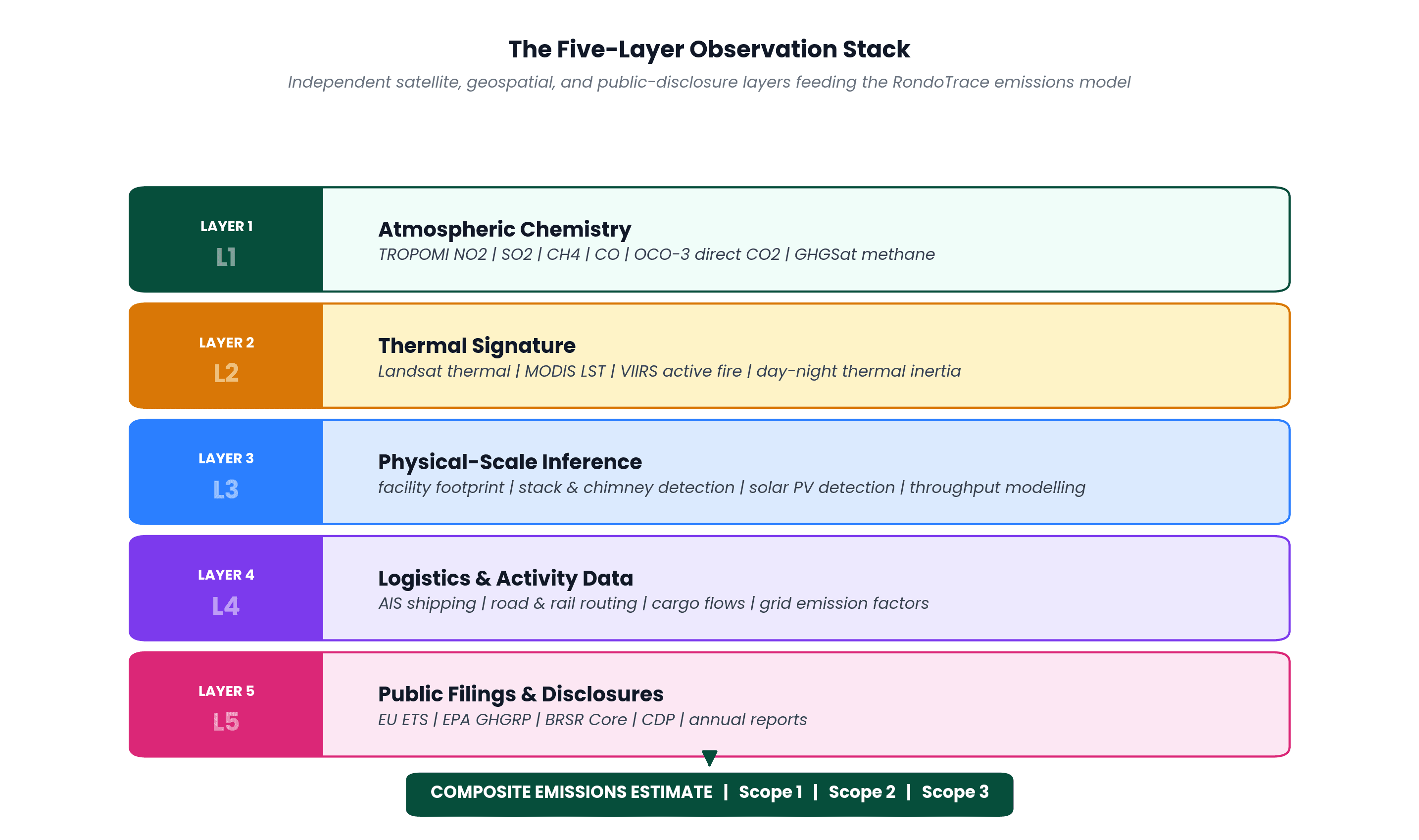
Five independent observation layers
We do not estimate emissions from a single sensor. We estimate them from five independent data streams, each measuring a different physical quantity. When the streams agree, confidence is high. When they disagree, the disagreement is itself a signal worth investigating.
Layer one — atmospheric chemistry. TROPOMI on Sentinel-5P measures NO₂, SO₂, methane, CO, and formaldehyde column densities globally every day. We apply Gaussian plume inversion to convert these column observations into emission rates at the source — the same physics-grounded methodology used in peer-reviewed climate science. For point sources large enough to resolve, we layer in OCO-3 direct CO₂ observations and GHGSat for methane fluxes at sub-facility resolution.
Layer two — thermal signature. Landsat 8 and 9 give us hundred-metre-resolution thermal imagery; MODIS gives us daily one-kilometre coverage; VIIRS gives us active fire and combustion radiative power. The thermal output of a steel blast furnace, a cement kiln, a refinery flare, or a coal power plant is a direct function of its production throughput. We invert this relationship: from observed thermal intensity, we estimate the throughput; from throughput, we estimate Scope 1 emissions.
Layer three — physical-scale inference. Sentinel-2 multispectral imagery at ten-metre resolution lets us detect facility footprint, count and size industrial stacks, identify on-site solar PV arrays, and measure the built-up area of the facility complex. A two-hundred-hectare cement plant cannot emit the same as a twenty-hectare one, regardless of what its annual report says. Physical scale is the sanity check on every chemical and thermal observation.
Layer four — logistics and activity data. AIS shipping data tells us what enters and leaves every port serving the facility. Road and rail routing data, combined with cargo flow estimates, gives us upstream and downstream transport emissions. The IEA’s country-level grid emission factor database, refreshed annually, gives us the carbon intensity of any electricity the facility purchases from the grid.
Layer five — public filings and disclosures. EU ETS verified emissions, the EPA’s Greenhouse Gas Reporting Program, India’s BRSR Core, CDP disclosures, and corporate annual reports give us a verified ground-truth layer for the subset of facilities that are subject to mandatory or voluntary reporting. We extract this data continuously and reconcile it against our satellite-derived estimates — both as a calibration input and as a cross-check.
The combination is what produces a defensible number. Any single layer can be wrong; all five being wrong in the same direction is improbable.
How the three scopes get estimated
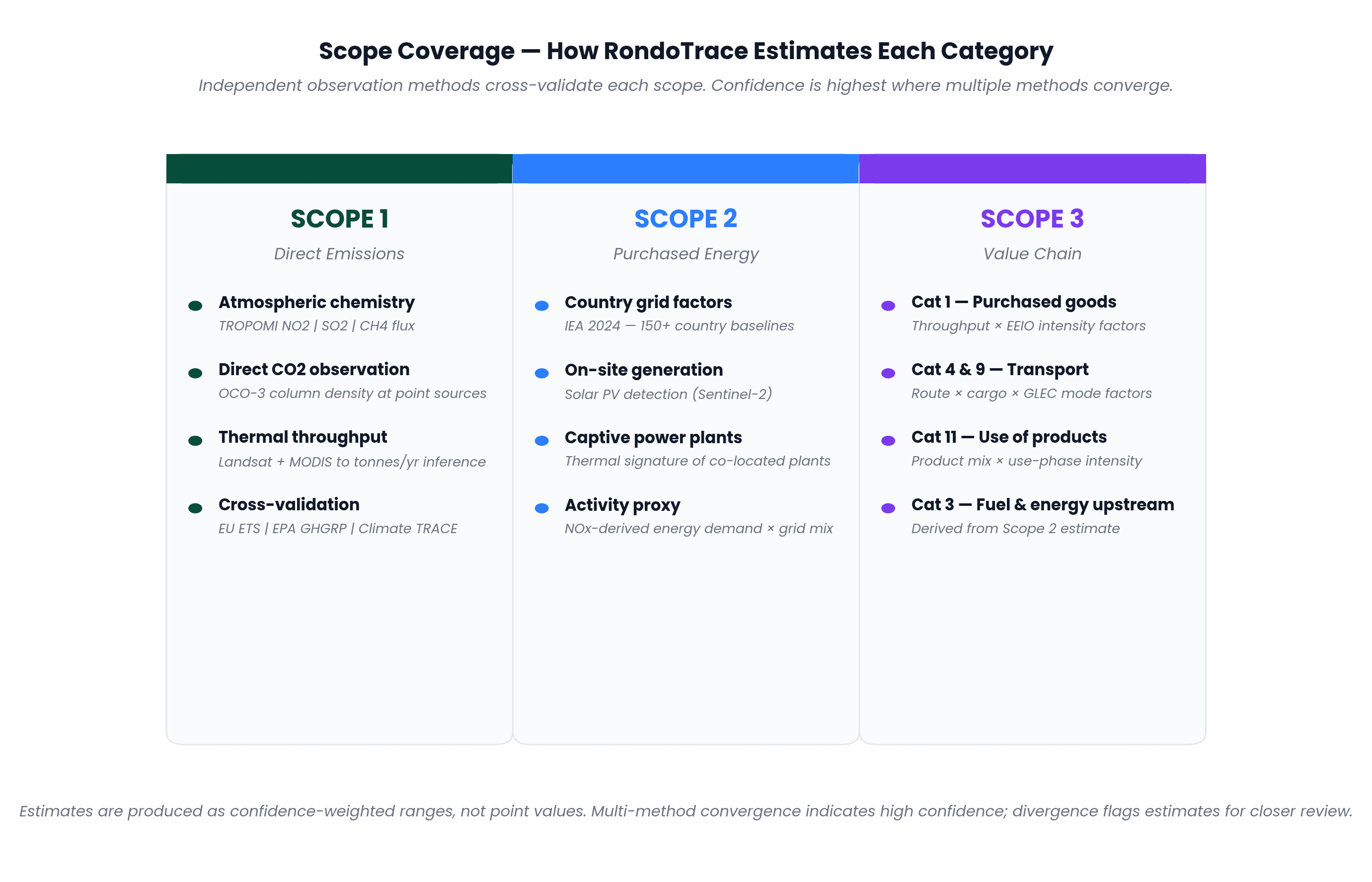
The five observation layers feed into three distinct estimation pathways — one for each scope category. Here is what we actually do for each.
Scope 1: direct emissions
Scope 1 is what comes out of the facility’s own combustion sources, process emissions, and on-site activities. We estimate it three ways simultaneously.
The first is the atmospheric chemistry path. The Gaussian plume inversion of TROPOMI NO₂ gives us a direct emission rate in tonnes per year. We multiply by industry-specific NO₂-to-CO₂ ratios calibrated against verified facility-level emissions in the EU ETS database. For methane-dominant facilities — coal mines, oil and gas operations, landfills, livestock — we layer in TROPOMI CH₄ flux estimates and apply the GWP-100 conversion to bring methane into CO₂-equivalent terms.
The second is the thermal throughput path. For steel blast furnaces, we model crude steel production as a function of integrated thermal output across the facility’s primary processing zone. For cement kilns, we model clinker production from kiln thermal signatures. For coal-fired power plants, we model generation in MWh from total facility thermal output and apply the IPCC default emission factor for the fuel type. Each model is calibrated against operators with verified disclosures, then applied to facilities without them.
The third is direct CO₂ observation. For point sources large enough to resolve at OCO-3’s footprint, we use the column-density anomaly directly. This pathway is most useful for the largest emitters in your portfolio — the ones that matter most for your aggregate Scope 3.
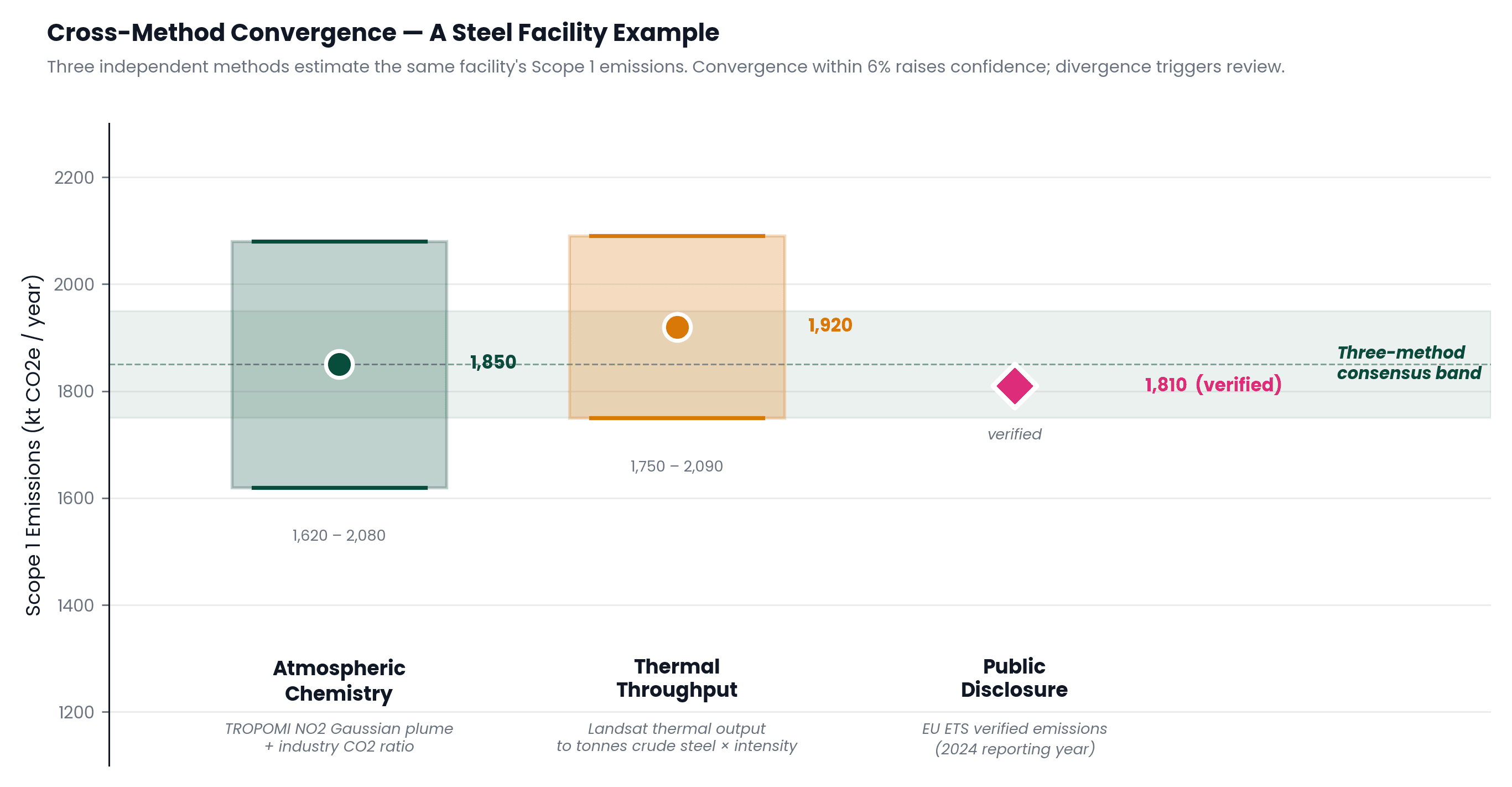
When all three methods agree within a tight band, the estimate is robust. When they disagree by more than thirty percent, we flag the facility for closer review — that disagreement usually tells us something interesting about the facility’s actual operations versus its declared profile.
Scope 2: purchased energy
Scope 2 is what your supplier buys from the grid. The conventional approach is to multiply reported electricity consumption by the country’s grid emission factor. We extend this in three ways.
We detect on-site generation directly. Solar PV arrays have a distinctive spectral signature in Sentinel-2 imagery that lets us locate and size them automatically. A supplier with twenty-two megawatts of on-site solar PV is not consuming the same grid electricity as one without — and the difference matters when you are estimating the supplier’s actual Scope 2 footprint.
We identify captive power plants on-site. Many large industrial sites, especially in emerging markets, run their own coal- or gas-fired generation. From orbit, captive power plants have a distinct thermal signature that lets us separate their emissions from grid-purchased electricity. Failing to do this is one of the most common errors in conventional supplier emissions accounting; an Indian steel mill with a 250 MW captive coal plant is a fundamentally different Scope 2 entity than one drawing 250 MW from the grid.
We estimate electricity consumption activity-independently. Even for facilities that report no consumption number, the NO₂ activity signature lets us estimate combustion and process intensity, which we translate into expected energy demand. Multiplied by the country’s grid factor and adjusted for any detected on-site generation, this produces a Scope 2 estimate for facilities that have never disclosed one.
Scope 3: value chain
Scope 3 is the hardest part of carbon accounting because it spans fifteen distinct categories under the GHG Protocol, most of which are not directly observable. We cover the categories that matter most for industrial OEMs.
Category 1, purchased goods and services, is estimated from the supplier’s modelled production throughput multiplied by economic input-output emission intensity factors specific to its industry. This is how you get a defensible number for the embedded emissions in components you buy from a supplier who does not itself disclose Scope 1 to you.
Category 4, upstream transportation, comes from AIS shipping data, road and rail routing models, and cargo flow estimates. We compute distance and tonnage for every shipping leg into the supplier’s site, multiply by GLEC emission factors by transport mode, and aggregate.
Category 9, downstream transportation, applies the same approach to the legs out of the supplier’s site to the next link in the chain.
Category 11, use of sold products, is modelled where relevant — for fuels, vehicles, machinery, and other categories where the use phase is the dominant emissions source. This requires some product-mix assumptions we generate from the supplier’s facility configuration and trade data.
Category 3, fuel and energy upstream, is derived directly from the Scope 2 estimate using IEA upstream factors.
The categories we deliberately do not cover at the supplier-site level — Categories 2 (capital goods), 5 (waste), 6 and 7 (employee travel and commuting), 12 (end-of-life), 13 (leased assets), 14 (franchises), and 15 (investments) — are either not satellite-observable or are outside the supplier’s site boundary. For these we apply industry-standard approaches and clearly distinguish them in the data lineage.
How this fits your existing carbon accounting workflow
This is the question most ESG heads ask first. The honest answer is that it slots in alongside what you already do.
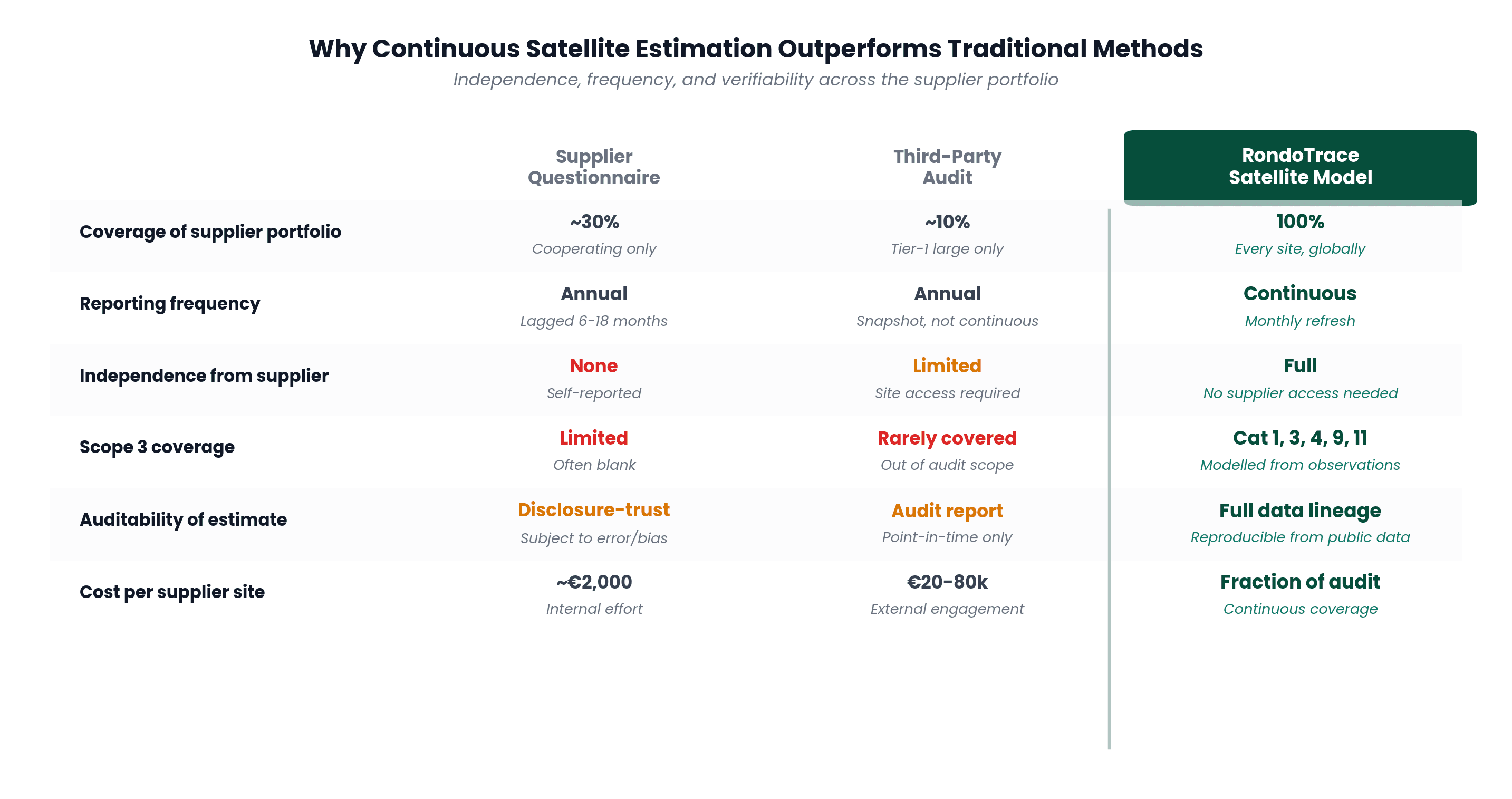
Your supplier questionnaires keep going out. Your audited disclosures keep coming in. Your annual sustainability report keeps getting published. RondoTrace adds a continuous, independent layer running in parallel — telling you, for every supplier site in your portfolio, what the satellite-observable physical reality actually shows. When a supplier’s disclosed number aligns with our estimate, you have triangulation, and you can publish that number with high confidence. When it does not align, you have an early warning that something in the supplier’s reporting is worth checking before the auditor finds it for you.
The continuous frequency matters as much as the independence. Carbon accounting based on annual disclosure is, by definition, twelve to eighteen months out of date by the time you publish it. RondoTrace refreshes monthly. If your supplier commissions a new captive power plant in February, your reported Scope 3 number for that supplier reflects it before your next reporting cycle, not after.
What this means for CSRD, CBAM, and CSDDD
Each of the three regulations wants something subtly different, and the satellite-derived estimate is useful for each in a different way.
For CSRD Scope 3 reporting, your published numbers need a defensible methodology behind them. Industry-average factors no longer satisfy auditors who have started asking pointed questions about specific high-emission suppliers. A satellite-derived estimate, with full data lineage from public observations through documented inversion methodology, is auditable in a way that “we used a default factor” is not.
For CBAM verification, importers must verify the embedded carbon in steel, aluminium, cement, fertilisers, hydrogen, and electricity from non-EU suppliers. Suppliers will increasingly produce CBAM declarations, and your job is to verify them. A continuous satellite estimate is precisely the kind of independent check the regulation contemplates — and importers who can demonstrate independent verification of their suppliers’ CBAM numbers will face much lower scrutiny than those who cannot.
For CSDDD due diligence, the directive’s “appropriate measures” standard explicitly contemplates digital tools. Continuous monitoring of supplier-side environmental indicators — including emissions trajectories — is exactly the kind of evidence-based, between-audit observation the directive’s Article 19 implementation guidance is expected to reference.
Across all three, the underlying value is the same: a defensible, continuous, independent carbon estimate for every supplier site in your portfolio, regardless of whether the supplier itself participates.
What you should ask before integrating any satellite carbon platform
If you are evaluating satellite-based emissions intelligence for your supplier portfolio, three questions separate the serious platforms from the marketing-led ones.
First, what is the data lineage for any specific number? You should be able to trace any reported emissions estimate back through the model to the underlying public satellite observations. If the methodology is opaque or proprietary in a way that prevents auditor walk-through, the number will not survive scrutiny.
Second, how is the model calibrated? An emissions estimation model that cannot demonstrate calibration against verified third-party-audited emissions — EU ETS, EPA GHGRP, BRSR Core — is making claims it cannot back up. Calibration against verified numbers is what separates a defensible estimate from a plausible-looking guess.
Third, how does the platform handle multi-method disagreement? If three independent observation methods produce different numbers for the same facility, the right answer is not to pick one and ignore the others. The right answer is to flag the disagreement, surface it to the user, and use it as a signal to investigate further. Platforms that present a single confident number and hide the underlying methods are hiding the most useful diagnostic information they have.
RondoTrace was built to satisfy all three. The methodology is documented; calibration runs continuously against every verified disclosure available globally; multi-method disagreement is surfaced to the user as a feature, not buried as a bug.
Why this matters now
The window for treating supplier-side emissions as a self-reported, annually-disclosed problem is closing. CSRD has already closed it for in-scope companies. CBAM closes it for importers of carbon-intensive goods. CSDDD closes it for the broader supply chain due diligence framework. The OEMs that will navigate the next three years cleanly are the ones that move beyond supplier-disclosure-only carbon accounting before their auditors and regulators force them to.
Continuous satellite emissions intelligence is how that move happens. The technology has matured. The data is available. The methodology is calibrated against the most rigorous public emissions disclosures in existence. What remains is integration into your carbon accounting workflow.
If you are thinking about how to put a defensible number behind every Scope 3 supplier line in your next CSRD report, or how to verify your tier-1 CBAM declarations without taking the supplier’s word for it, we would value the conversation.
RondoTrace provides continuous satellite-based emissions intelligence for industrial supply chains, supporting CSRD, CBAM, and CSDDD compliance for European OEMs and importers. To explore how the platform fits your supplier portfolio, contact us at adarsh@rondotrace.com.
Related analysis
More from RondoTrace.

The same methodology, applied to a site you choose.
Forensic retrospective on any supplier site — including yours. We deliver the methodology, the imagery, the dated observations, and the limitations. Thirty days, no commitment.