 RondoTrace
How to monitor tier 2 to tier 4 suppliers without questionnaires
Last updated:
In short
You can monitor tier 2 to tier 4 suppliers without questionnaires by identifying the physical sites behind them and measuring those sites directly from orbit. RondoTrace follows named mines, smelters, plants and sourcing areas this way, so the evidence does not depend on a reply from a company you have no contract with.
Why questionnaires stop at tier 1
A questionnaire works where you have a contract. Your direct supplier answers because you are the customer. The refinery that supplies them, and the mine that supplies the refinery, have no reason to answer you, and often your supplier will not name them. The further back the chain goes, the less a cascade of forms returns.
Monitoring the site directly takes a different route. If you know where a mine, a smelter or a plantation area is, it can be measured without anyone there replying to anything.
How it works in practice
The first step is finding the sites. We resolve a supply chain several tiers deep, to named companies and physical sites, using corporate filings, trade and customs records, facility registries and material flows. Each link carries a confidence level, so you can tell a confirmed link from an inferred one. Where you already know the sites, this step is short.
The second step is watching them. For each site we measure what fits it, for example forest loss around a mine or heat at a smelter, and compare each reading with the site's own history and its surroundings.
A worked example: Weda Bay, Indonesia
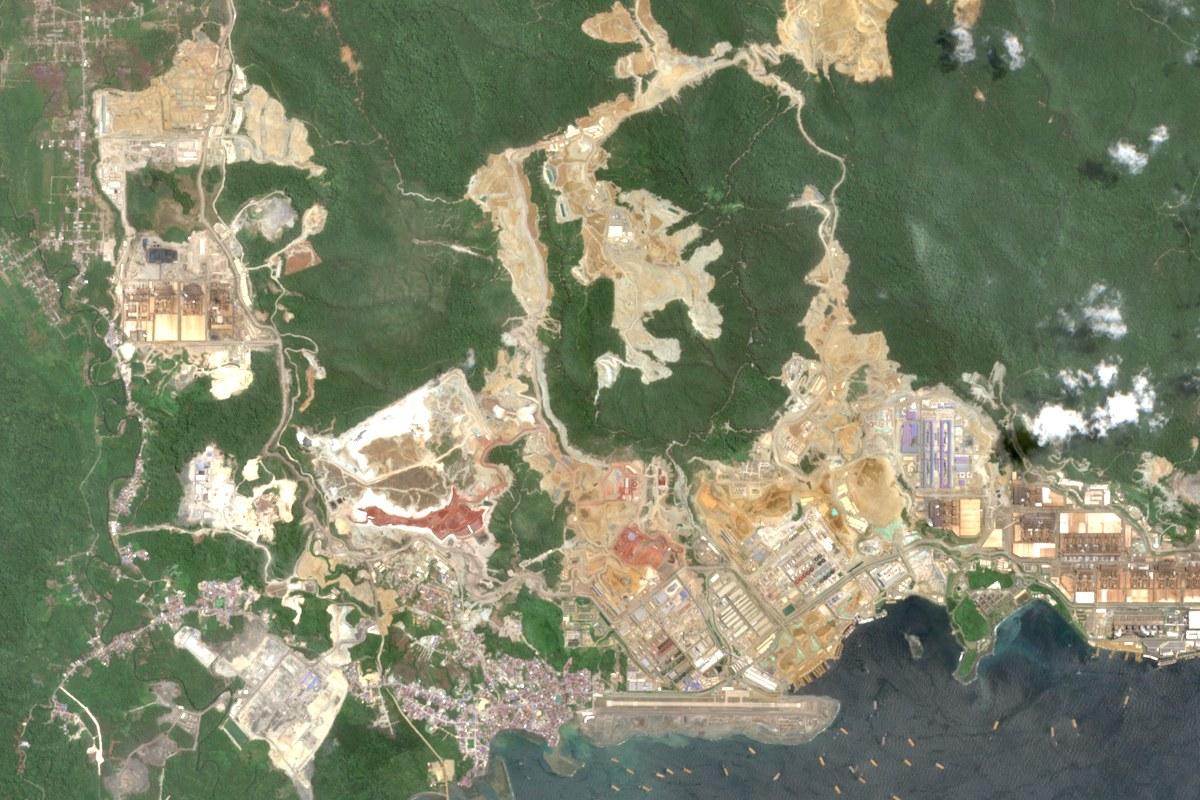
Weda Bay on Halmahera is a nickel mining and processing area in the battery supply chain. It is in our Outlook tool for sustainability teams. Our first reading, for the six months to 31 October 2021, showed 54 hectares of forest-disturbance alerts. The six months to 31 October 2025 showed 146 hectares. The six months to 31 October 2026 showed 654 hectares, the highest half-year on our record and more than four times the figure a year earlier.
None of this needed a reply from the operator. The alerts show that tree cover was disturbed in this area. They do not show who did it, or whether your own nickel came from this ground.
Limits
Direct monitoring only works for sites that have been identified. An inferred link in a supply chain map can be wrong, and we mark it as inferred. Satellite evidence shows a change at a place and does not show who caused it. It cannot see working conditions, wages, contracts or finances, which are the things a questionnaire asks about. Cloud and tree cover hide the ground. We do not predict incidents, and we do not say how likely one is.
Who uses this and for what
- Procurement teams use it to see past tier 1 for the materials where a single mine or refinery matters.
- Sustainability and due diligence teams use it as independent evidence about sites they cannot audit.
- Risk teams use it to find out when several suppliers depend on the same site.
Questions buyers ask
Do we need to know our tier 2 to tier 4 suppliers already?
It helps, but it is not required. Where you know the sites, we start monitoring them. Where you do not, we work back from your direct suppliers using public records and mark each link as confirmed or inferred.
What if a link in the chain is only inferred?
We say so. An inferred link means the records point to this site without confirming it. The evidence about the site is still real, and whether your own material passes through it remains a question for your supplier.
Does this replace supplier questionnaires?
No. A questionnaire can ask about policies, labour and management, which cannot be seen from orbit. Direct monitoring covers the sites that never answer and gives you something to check the answers against.
Which materials does this suit best?
Materials that come from large, fixed sites: metals from mines and smelters, and commodities such as palm oil that come from identifiable sourcing areas. It suits small workshops and traders poorly, because there is little to measure from orbit.
You can try this on real sites in the Outlook tool, ask for a first reading of a site of your own at Check a site, or read Satellite monitoring compared with supplier audits, certifications and questionnaires.