 RondoTrace
Brumadinho Dam Collapse: What Our AI Detected About Eleven Months Before Failure — Using Only Satellite Data
Three of four independent risk detection layers fired, months before the collapse. Traditional sensors detected nothing.
By RondoTrace · April 2026 · 12 min read
On January 25, 2019, Dam I at Vale’s Córrego do Feijão mine in Brumadinho, Brazil collapsed without warning. Twelve million cubic metres of liquefied tailings swept through the mine’s administrative area, a railway bridge, farmland, and parts of a nearby community. 270 people were killed. It was the deadliest mining disaster in Brazil’s history.
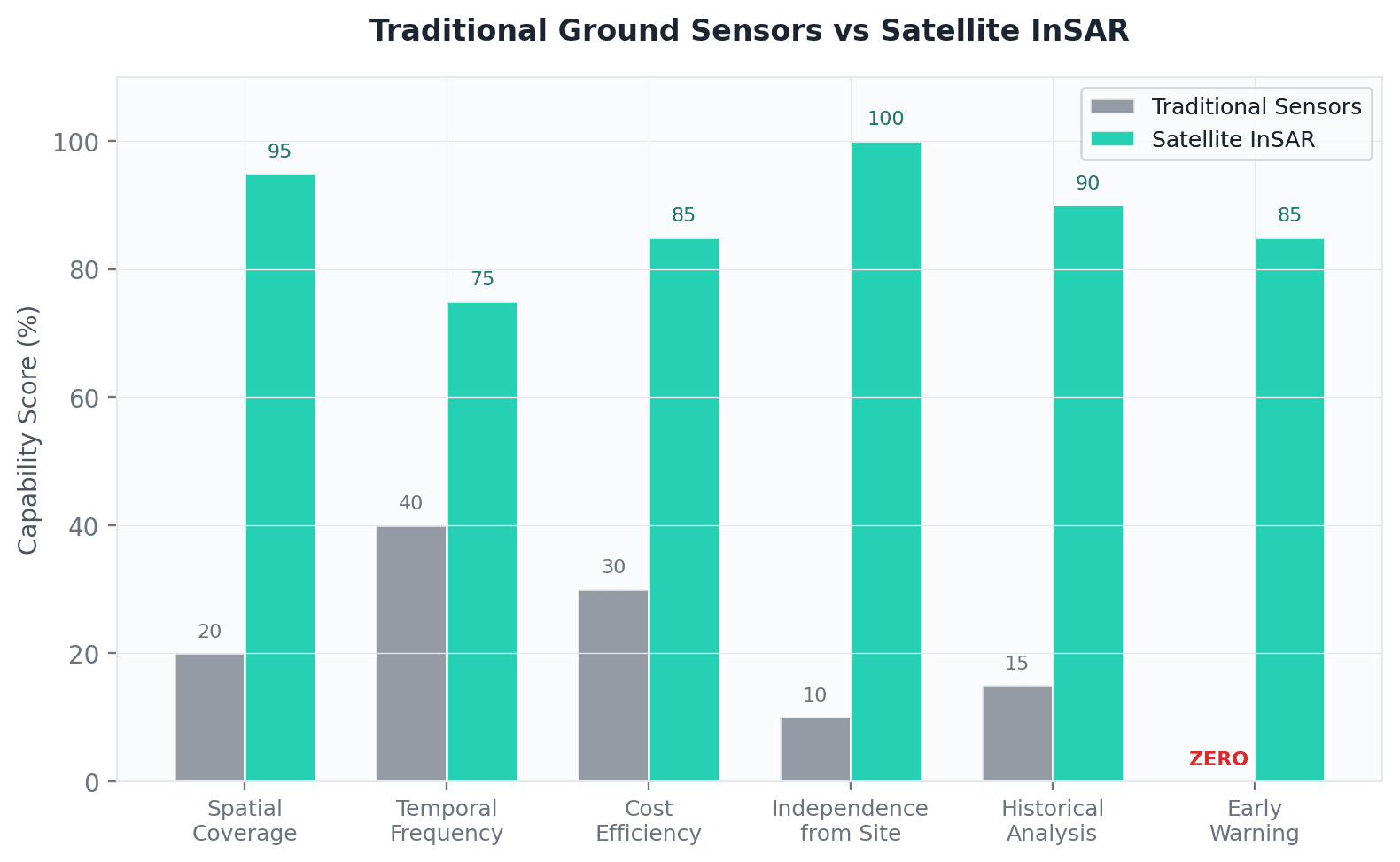
Every traditional ground sensor on the dam — piezometers, inclinometers, survey prisms — showed nominal readings. No alarms were triggered. No evacuation order was given. The dam’s stability certification had been renewed just months earlier.
Every traditional sensor detected nothing. Our system detected everything.
RondoTrace conducted a retrospective forensic analysis of Brumadinho Dam I, processing satellite radar data through our multi-layer intelligence engine. Three of four independent risk detection layers fired: spectral divergence, variance anomaly and re-acceleration. The system escalated to CRITICAL risk status. The fourth, the Fukuzono failure-date model, did not trigger. Fitted on the full record, it placed the failure point before the last observation rather than ahead of it, so it gave no forward date.
RondoTrace Is Not a Satellite Processing Tool — It Is an AI Risk Intelligence Engine
Before we walk through the Brumadinho findings, it is important to understand what RondoTrace actually does, because it is fundamentally different from conventional satellite imagery platforms.
Most remote sensing companies deliver processed images, displacement maps, or change-detection layers. They give you pixels. What you do with those pixels is your problem.
RondoTrace is an end-to-end AI intelligence system that ingests satellite data across multiple sensor types — radar interferometry, multispectral imagery, atmospheric composition — and continuously analyses it through layered detection algorithms designed to find patterns that humans miss. It doesn’t just measure displacement; it interprets displacement in context, cross-referencing structural behaviour against environmental signals, atmospheric baselines, and temporal patterns to distinguish real risk from noise.
The platform operates seven interconnected analysis modules: infrastructure stability (InSAR), environmental impact (NDVI/NDWI), air quality (atmospheric composition), emissions estimation, deforestation monitoring, human rights indicators, and transportation risk intelligence. These modules don’t operate in isolation. The system fuses signals across modules to build a composite risk picture. A tailings dam showing accelerating displacement becomes far more significant when the same site simultaneously shows declining vegetation in buffer zones, elevated dust signatures, or unusual nighttime activity patterns.
This is the difference between a thermometer and a doctor. A thermometer tells you the temperature. A doctor interprets the temperature in the context of other symptoms, patient history, and clinical knowledge to diagnose and predict.
At Brumadinho, our AI doctor diagnosed a dying dam — about eleven months before it collapsed.
What Is InSAR, and How Does RondoTrace Use It?
Interferometric Synthetic Aperture Radar (InSAR) is a satellite-based technique that measures ground surface displacement with millimetre-level precision. Radar satellites transmit C-band signals and captures their return phase across repeated passes. By processing dozens of these acquisitions through time-series analysis, we reconstruct how every point on a structure has moved over months or years.
But raw InSAR data is noisy, contaminated by atmospheric delays, orbital variations, and processing artefacts. This is where most satellite monitoring stops — handing engineers a displacement time series and hoping they notice something wrong.
RondoTrace goes further. Our engine processes the raw displacement data through four independent statistical detection layers, each designed to detect a different class of failure precursor. These layers operate autonomously and continuously. When multiple layers fire simultaneously, the system synthesises their signals into a composite risk assessment. At Brumadinho, three of the four fired, and together they escalated the dam to CRITICAL.
The Brumadinho Analysis: What Our AI Found
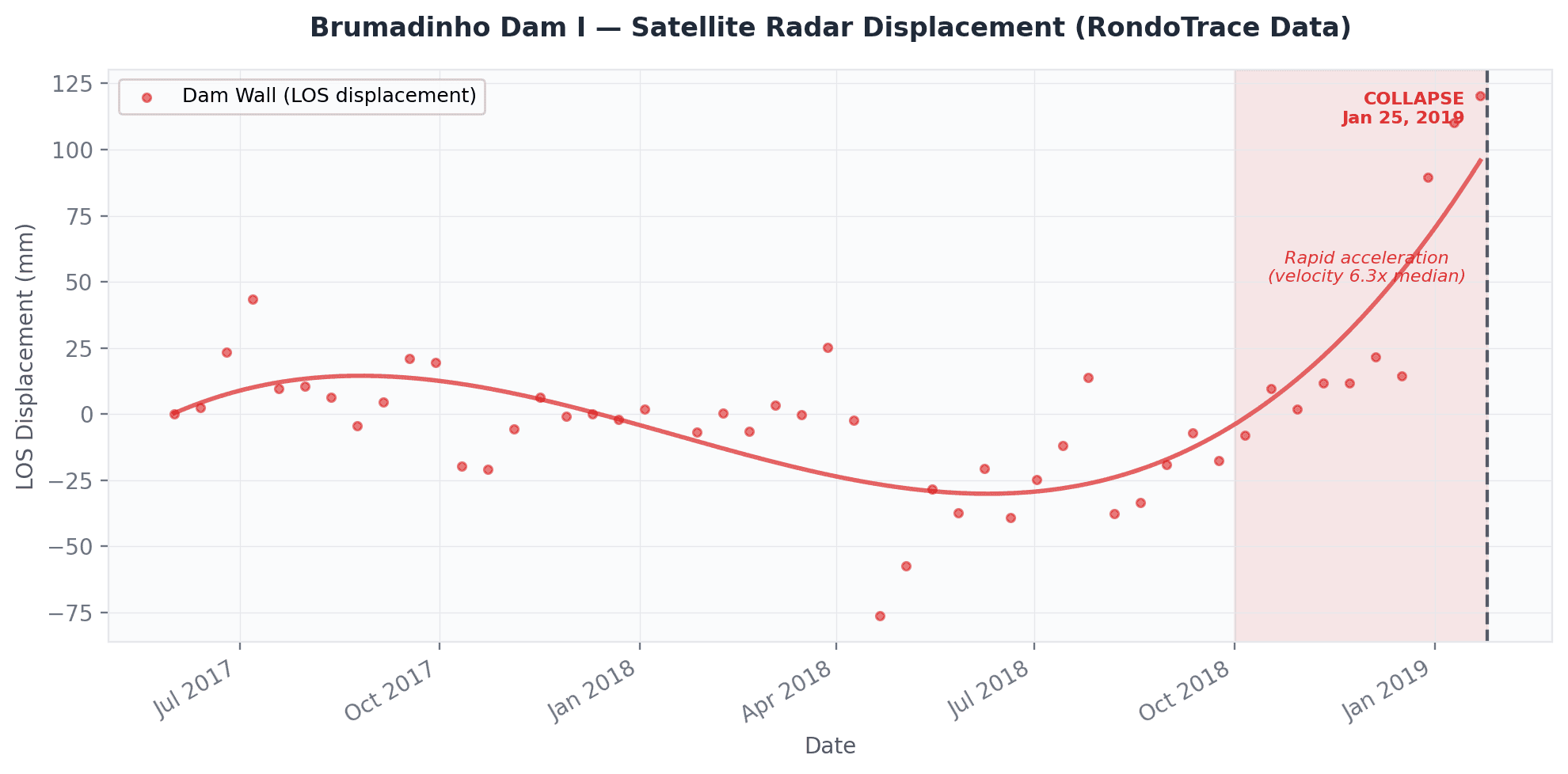
RondoTrace processed satellite radar acquisitions spanning June 2017 to January 2019 — 20 months of data, 50 observation epochs across 5 monitoring points (Dam Wall, Crest/Beach, Tailings Mid, Toe Area, and a Stable Reference point located on bedrock away from the mine).
The Dam Wall accumulated 120.5 mm of total displacement along the satellite’s line of sight. Velocity peaked at 1.82 mm/day — 6.3 times the historical median of 0.29 mm/day — and was 0.86 mm/day at the final observation. This is not gentle consolidation. This is a structure in accelerating failure.
The Stable Reference point maintained near-zero displacement throughout the monitoring period, confirming that the structural signals were real ground movement and not atmospheric artefacts.
Four Layers of Detection — Three Fired
RondoTrace’s risk engine applies four independent detection algorithms to every monitored structure. Each layer looks for a different class of failure precursor. At Brumadinho, three of the four triggered. Sustained high variance combined with re-acceleration escalated the system to CRITICAL risk status.
Layer 1 — Spectral Divergence (pq Score)
This layer uses information-theoretic metrics to measure how much the displacement pattern at each structural point diverges from its established baseline. A pq score above 0.10 indicates emergent risk. Above 0.20 indicates imminent failure.
At Brumadinho, the Dam Wall hit pq = 0.250 — the maximum possible classification uncertainty — in the window ending February 2018, about eleven months before collapse. The Toe Area reached pq = 0.248 in the final observation window. Four of five monitoring points exceeded emergent thresholds. The Stable Reference remained at pq = 0.079, well below alert levels, confirming the signals were structural.
Layer 2 — Variance Anomaly
This layer tracks the statistical variance of displacement signals over sliding windows. Sustained variance above 2x the baseline median indicates elevated risk. Above 4x indicates critical instability.
Our engine fired 14 variance alerts at Brumadinho. Six reached CRITICAL level, with variance peaking at 4.95x the baseline median in the final observation window. The variance pattern showed two distinct escalation phases: a first surge beginning in late 2017, and a second, more severe surge in the final months of 2018.
Layer 3 — Re-acceleration Pattern
This is the most dangerous signal our system detects. Re-acceleration occurs when variance drops significantly (suggesting the structure may be stabilising) and then surges past its previous peak — indicating that whatever process is driving the instability has resumed with greater force.
Two re-acceleration events were detected at Brumadinho. The first showed a 42% variance drop followed by a 257% surge. The second — in the final months — showed a 74% drop followed by a 285% surge. This pattern is a hallmark of progressive failure: the structure briefly appears to stabilise before accelerating toward collapse.
The combination of sustained high variance plus re-acceleration automatically triggered our highest classification: CRITICAL — active failure precursor.
Layer 4 — Fukuzono Inverse Velocity (Failure-Date Model)
The Fukuzono method, developed from geotechnical research on landslide and slope failures, plots the inverse of displacement velocity over time. When this value converges toward zero, failure is imminent. The date at which the trend line crosses zero is the model’s estimated failure date.
At Brumadinho, the model was fitted to the last eight observations at each of the four structural points, the final one on January 22, 2019. The fitted lines crossed zero on:
- Dam Wall: January 9, 2019 (R² = 0.70)
- Crest/Beach: January 10, 2019 (R² = 0.72)
- Tailings Mid: January 10, 2019 (R² = 0.76)
- Toe Area: January 10, 2019 (R² = 0.66)
Every fitted crossing fell before the last observation it was fitted on, twelve to thirteen days before it. That is consistent with a structure at or past failure, not with a forecast, and the layer did not trigger.
The Timeline: Escalating Signals Through 2018
The forensic timeline reconstructed from our analysis is sobering. Each reading is dated by the end of the observation window it needed. The Dam Wall crossed the imminent spectral threshold in the window ending February 2018. The first re-acceleration came in the window ending April 2018, and variance went critical in the window ending August 2018. The failure-date model never triggered.
During this entire period, no traditional ground sensor raised an alarm. The dam’s stability assessment was renewed. Operations continued normally. The administrative area — where most victims were located — remained occupied directly below the dam.
Why This Matters: From Retrospective Proof to Continuous Protection
The Brumadinho analysis is retrospective — we applied our engine to historical data after the fact. But it proves something critical: the signals were there. They were detectable. They were unambiguous. And they were detectable from orbit alone, with no site access, no sensor installation, and no cooperation from the facility operator.
This means continuous, forward-looking monitoring is not just possible — it is straightforward. A company monitoring its suppliers’ tailings dams through RondoTrace would have received escalating risk alerts for about eleven months before Brumadinho collapsed. Not a single alert — a sustained, multi-layered, multi-point cascade of warnings that would have been impossible to ignore.
And this is where RondoTrace’s multi-module architecture becomes decisive. Infrastructure displacement is one signal. But our platform simultaneously monitors vegetation health around the site, atmospheric emissions, deforestation risk, and human rights indicators. Each module feeds into a composite risk score that captures the full picture of what is happening at a supplier’s facility.
A tailings dam showing accelerating displacement is concerning. A tailings dam showing accelerating displacement while simultaneously showing declining buffer vegetation, elevated particulate emissions, and recent expansion into undeveloped land is a crisis. RondoTrace sees all of these signals simultaneously, continuously, and independently.
The Regulatory Imperative
For European companies, the regulatory landscape now demands exactly this kind of independent, continuous monitoring.
The Corporate Sustainability Due Diligence Directive (CSDDD) requires companies to identify, prevent, mitigate, and account for adverse human rights and environmental impacts across their value chains. The Corporate Sustainability Reporting Directive (CSRD) demands disclosure of material environmental risks. The EU Deforestation Regulation (EUDR) requires geolocation-level evidence of deforestation-free supply chains. The Carbon Border Adjustment Mechanism (CBAM) will require verified emissions data for imported goods.
These regulations share a common requirement: independent, verifiable evidence of due diligence. Supplier questionnaires and annual audits are no longer sufficient. Regulators want continuous monitoring, and they want evidence that doesn’t come from the party being monitored.
Satellite intelligence provides exactly this. It is independent, continuous, verifiable, and admissible. And as Brumadinho proves, it detects risks that traditional methods miss entirely.
Methodology Note
This analysis was conducted by RondoTrace using satellite radar data.
The displacement values, risk scores and detection-layer outputs in this article come from a single retrospective run of the RondoTrace analysis engine on the Brumadinho site, stored with the displacement series it was run on. Three of the four layers triggered; the Fukuzono layer did not. The 4-layer risk analysis (spectral divergence, variance anomaly, re-acceleration detection, and Fukuzono inverse velocity) is our proprietary methodology, built on established academic foundations in SBAS InSAR processing and geotechnical failure prediction. The analysis covers 50 observation epochs across 5 monitoring points from June 2017 to January 2019.
The Fukuzono failure prediction model is based on the inverse velocity method (Fukuzono, 1985), widely used in geotechnical engineering for slope failure prediction. Our implementation extends this with automated segment detection and multi-point convergence analysis.
Every traditional sensor detected nothing. Our system detected everything.
— RondoTrace forensic analysis
Related analysis
Other cases in the record.

The same methodology, applied to a site you choose.
Forensic retrospective on any supplier site — including yours. We deliver the methodology, the imagery, the dated observations, and the limitations. Thirty days, no commitment.