 RondoTrace
Monday Morning, 200 Suppliers, One Dashboard
How satellite intelligence fits into real ESG workflows — from alert to action.
By RondoTrace · 15 April 2026 · 5 min read
You have 200 suppliers across 14 countries. Last quarter, you sent due diligence questionnaires to all of them. 60% responded. Of those, you trust maybe half the answers. The rest are best guesses, outdated certifications, and copy-pasted compliance language from last year.
Meanwhile, one of those facilities had its SO₂ emissions double in November. Another hasn’t had a maintenance shutdown in seven months. A third is showing progressive vegetation loss in the buffer zone around its perimeter — the kind of pattern that often precedes a water contamination finding.
You didn’t know any of this. You couldn’t. The questionnaire doesn’t ask, and even if it did, the answers would arrive in March for conditions that changed in October.
This is the gap that satellite intelligence closes.
What an ESG team actually sees
Here is what Monday morning looks like when continuous satellite monitoring is active across your supplier portfolio.
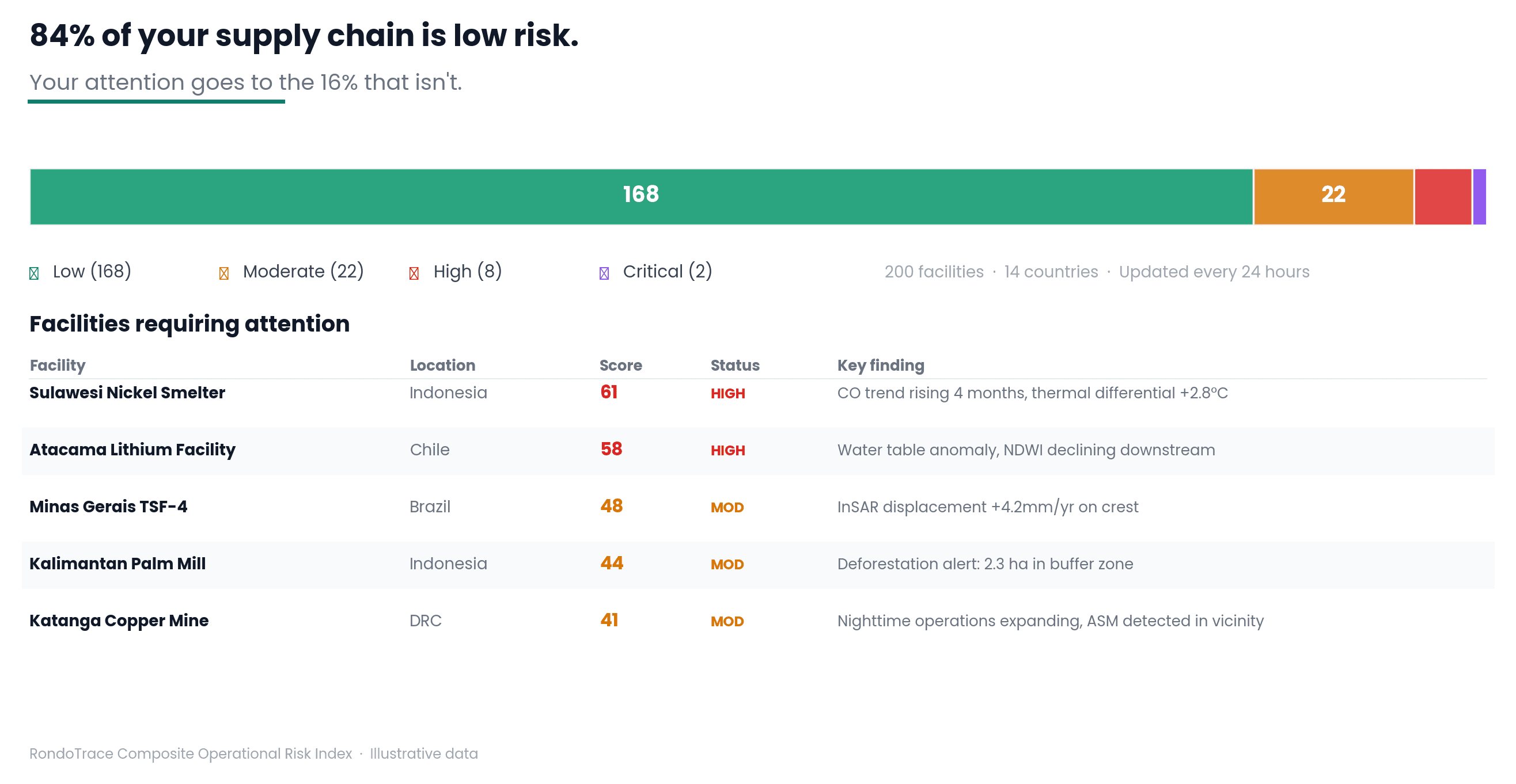
You open your dashboard. Each supplier site has a Composite Operational Risk Index — a single score from 0 to 100, colour-coded: green for low, amber for elevated, red for critical. The score is calculated from a weighted combination of atmospheric emissions, thermal behaviour, ground stability, vegetation health, water quality, operational patterns, and land use change. Each indicator is tracked independently, but they feed into one composite view.
Most of your sites are green. They have been green for months. That is the point — you do not need to spend time on facilities that are operating within their normal parameters.
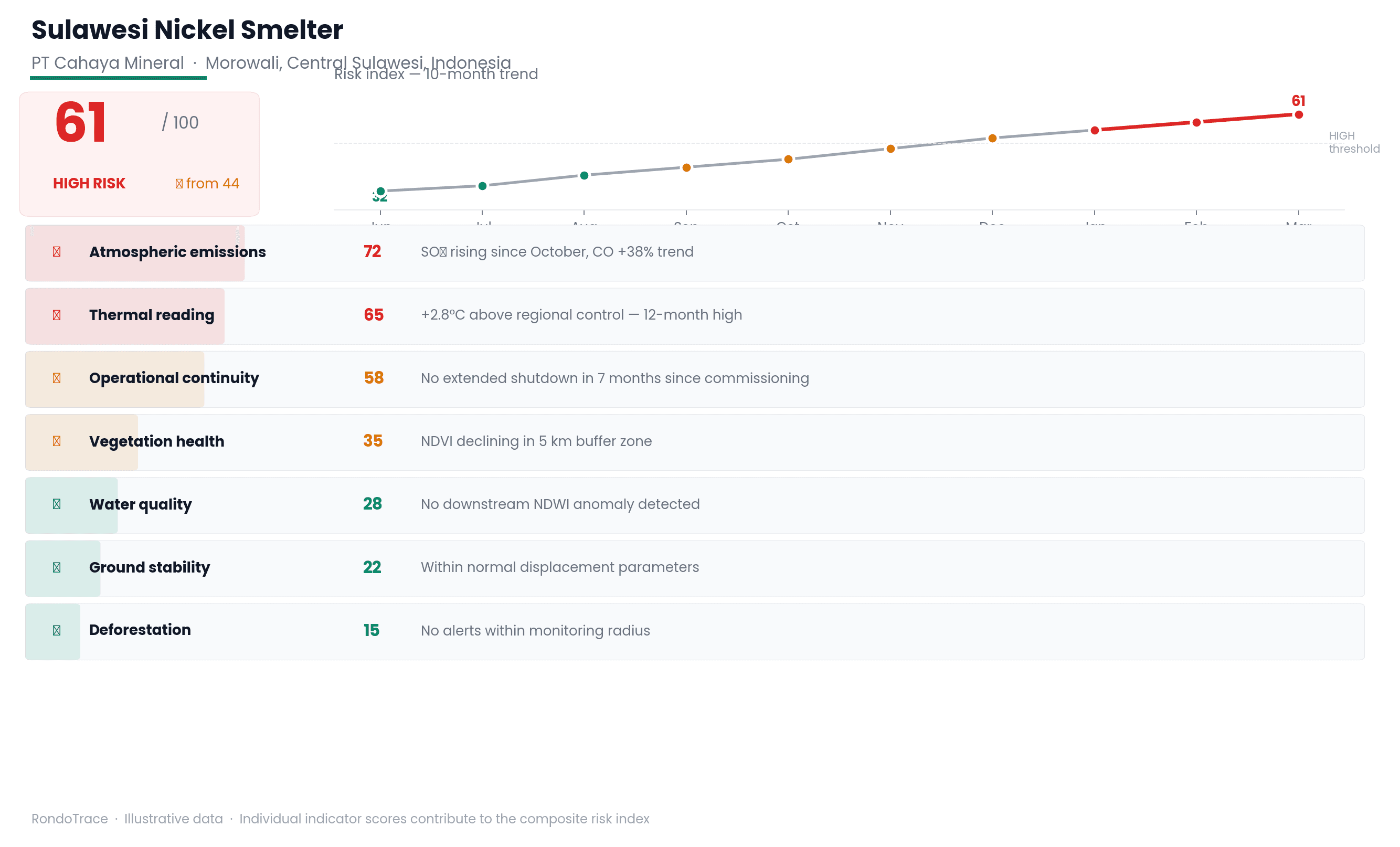
But today, a nickel smelting facility in Sulawesi, Indonesia has moved from 44 (moderate) to 61 (high). It crossed the threshold overnight.
You click into it. The system shows you what changed: carbon monoxide has been rising steadily for four months. The facility’s thermal reading is 2.8°C above the regional control baseline — the highest in a year. Nighttime operational data confirms the facility has been running continuously without an extended shutdown since commissioning.
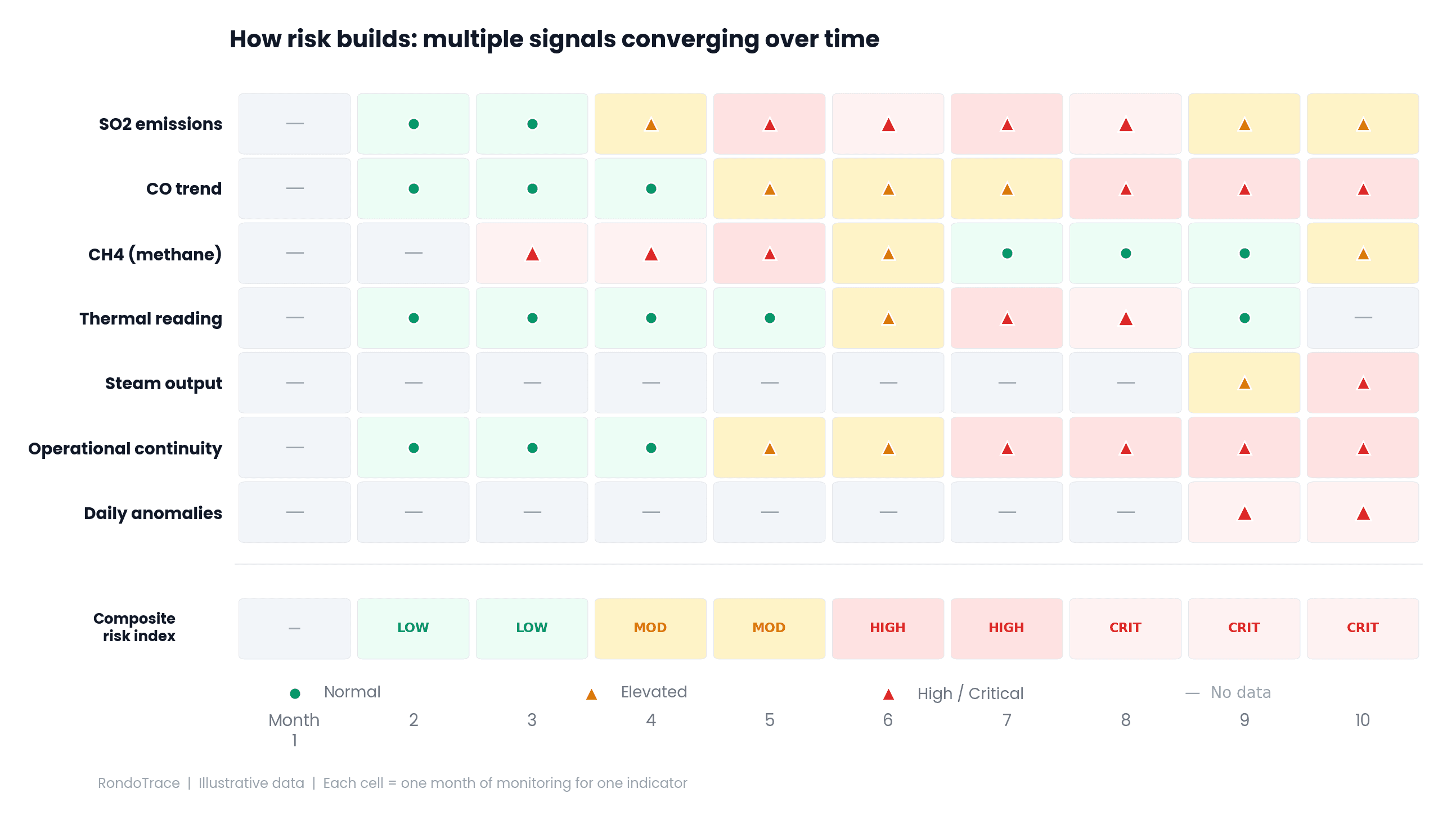
No single indicator is alarming on its own. A CO trend can reflect fuel quality changes. A thermal differential can reflect seasonal variation. Continuous operations are not inherently dangerous. But when multiple independent indicators move in the same direction, at the same facility, over the same period — that convergence is what the system is trained to detect.
When multiple independent indicators move in the same direction, at the same facility, over the same period — that convergence is what the system is trained to detect.
The dashboard recommends: Request compliance documentation from the facility operator. Consider scheduling an independent inspection of combustion and emission control systems.
You did not need to read a 40-page questionnaire. You did not need to wait for a self-reported emissions figure. The facility’s own operational signature told you something had changed.
How the model learns what “abnormal” looks like
Every industrial facility has a signature — a pattern of emissions, temperature, and operational activity that is unique to its type, location, and season. A coal-fired power plant in Southeast Asia during monsoon season has a different baseline than the same plant in winter. A zinc smelter in the Atacama has a different thermal profile than a chemical plant in Belgium.
The model builds each facility’s baseline from its own historical data, cross-referenced against regional control sites 20–30 km away to filter out weather, seasonal variation, and regional pollution sources. Anomalies are scored against the facility’s own rolling average — not an industry benchmark, not a theoretical limit, but what this facility normally does.
In addition, the model is calibrated against a reference database of historical industrial incidents. It has studied the satellite-observable patterns that preceded well-documented failures — the atmospheric chemistry shifts before structural collapses, the thermal escalation before equipment failures, the operational patterns that tend to precede safety incidents. When a facility’s current signature begins to match those patterns, the risk score escalates.
This is not prediction. The model cannot tell you that a specific boiler tube will fail on a specific date. What it can tell you is that a facility is operating outside the parameters associated with stable, well-maintained operations — and that the pattern has historically been associated with elevated risk. The value is in triggering the on-site inspection that finds the specific problem, not in diagnosing the problem remotely.
What you do with the intelligence
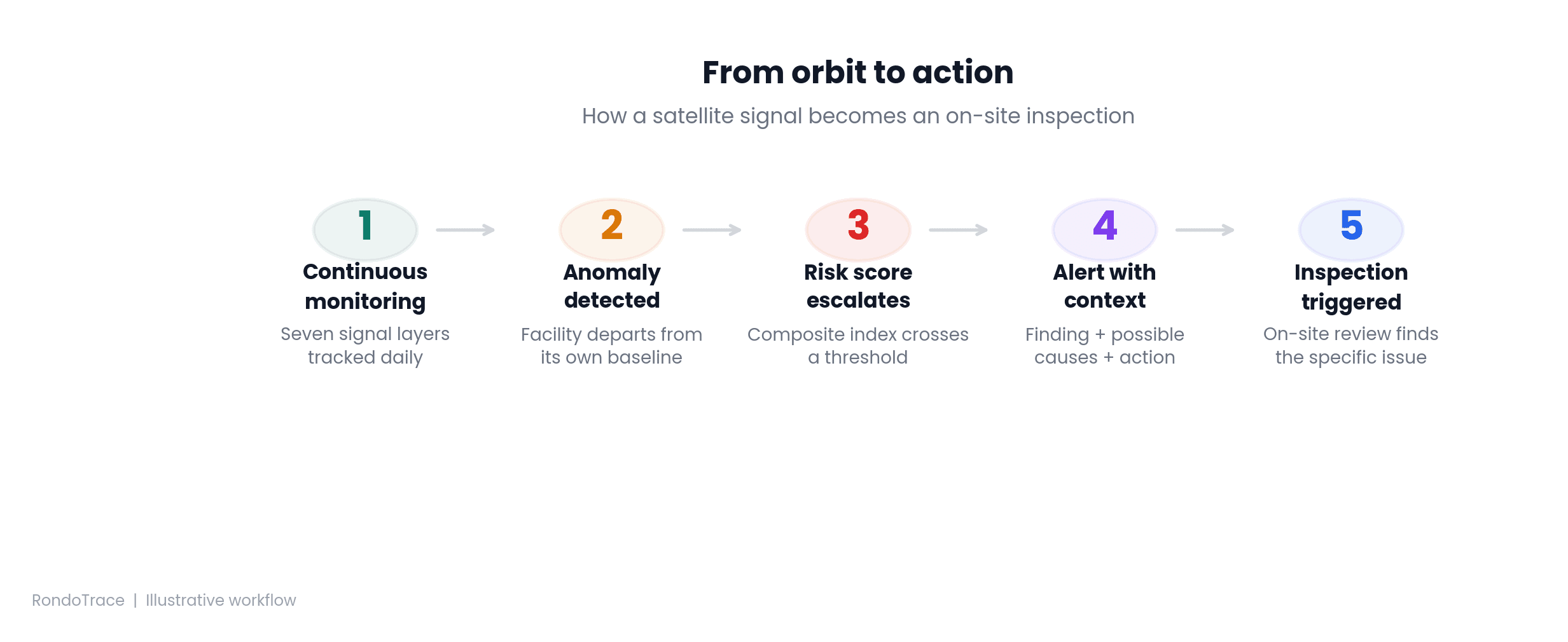
The output is designed to fit into existing workflows, not replace them. There are four primary use cases:
Supplier engagement. When a site crosses a risk threshold, the system generates a structured finding that your procurement team can include in their next supplier review meeting. The finding includes what changed, when it changed, and what it might indicate — with appropriate context about alternative explanations. This transforms a vague “we have ESG concerns” conversation into a specific, data-backed inquiry.
Regulatory evidence. Under CSDDD, companies must demonstrate they have taken “appropriate measures” to identify and mitigate risks in their value chain. Under CSRD, environmental data for ESRS E1 (climate), E2 (pollution), and E4 (biodiversity) must be reported with increasing specificity. Continuous satellite monitoring provides a timestamped, independently verifiable evidence trail that documents both the monitoring activity and any findings. If a regulator asks what you knew and when you knew it, the system provides the answer.
Internal reporting. The Composite Operational Risk Index rolls up into a portfolio-level view. Your board sees a heat map of 200 facilities with trend lines. They can see that 85% of your supply chain is green, 12% is amber, and 3% is red — and that the red percentage has decreased from 7% since you began monitoring. This is the kind of quantified risk reduction narrative that sustainability reports need.
Early intervention. The highest-value use case is the simplest: catching problems early. A facility that is gradually running hotter, emitting more, and showing irregular operational patterns is a facility that may be heading toward an incident — environmental, safety, or both. The January alert that triggers an inspection is worth more than the April headline that triggers a crisis.
What it does not do
It does not replace on-site audits. It does not diagnose specific equipment failures. It does not measure Scope 3 emissions with accounting-grade precision. It does not tell you whether a facility’s workers are treated fairly — though nighttime operational patterns and settlement indicators can flag situations that warrant closer human investigation.
What it does is solve the coverage problem. You cannot audit 200 facilities continuously. You cannot station inspectors at every site. But you can monitor all of them from orbit, every day, and direct your limited inspection resources to the facilities that need them most.
The data exists whether you use it or not. Every day, seven classes of satellite sensors pass over your supply chain and record what they see. The question is whether anyone is looking.
RondoTrace provides continuous satellite intelligence for supply chain ESG risk monitoring. To learn how our platform integrates with your existing compliance workflows, contact us at adarsh@rondotrace.com.
Related analysis
More from RondoTrace.

The same methodology, applied to a site you choose.
Forensic retrospective on any supplier site — including yours. We deliver the methodology, the imagery, the dated observations, and the limitations. Thirty days, no commitment.