RondoTrace
WORKER SAFETY ALERT
Processing factory injury
CTC machine; inspector suspended.
Primary source: NewsClick (Jul 2022)
It had no scandal, no NGO file, no alerts. Four years of satellite data and the local press told a different story.
By RondoTrace · 27 May 2026 · 8 min read
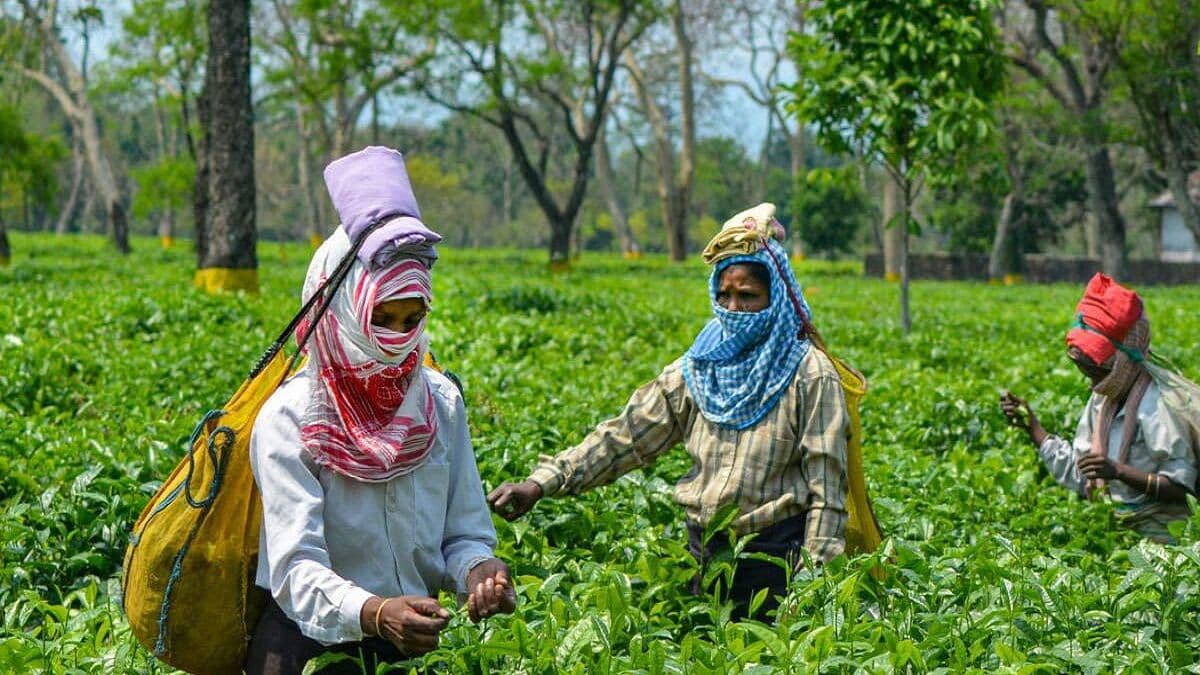
Take a sustainability leader at a European tea buyer through their supplier list. Ask them which sites they’re worried about. The names that come up are the ones with a scandal attached, an NGO report on file, or a flagged certification audit. They are usually the ones already being dealt with.
We were interested in the opposite problem. The supplier sites that nobody is worried about.
We picked Lepetkata Tea Estate, in the Dibrugarh district of Assam. It is operated by Luxmi Tea Company, an old name in Indian tea. From the air, on most days, it looks like any of the hundred other estates that stretch across the upper Brahmaputra valley. There has been no public scandal. No NGO report. No active alert from any global forest-monitoring system. To the standard supplier risk stack — the questionnaires, the certifications, the audit feeds — Lepetkata is a quiet site.
We watched it for four years from space. Then we read the local press from the same window.
What we found is in this case study. But the more interesting question — and the one we want you to keep in mind throughout — is not what was happening at Lepetkata. It is what is happening at the dozens of other Lepetkatas in your supply chain that you have not yet looked at this way.
Between January 2022 and December 2025, our monitoring engine watched four things in parallel at this site: changes to the forest and land cover, the chemistry of the air above it, the spectral signature of the surface, and the pattern of settlement around it.
The forest layer flagged 28.6 hectares of post-2020 forest loss inside the ten-kilometre buffer around the Bolai division. This is the window that matters for EUDR. None of the major global deforestation alert systems flagged any of it, because their detection logic is built for the kind of clearing that happens in Brazilian primary forest, not the slower, more fragmented pattern that happens in Indian plantation country.
The air chemistry layer flagged twenty-four separate emissions anomalies above baseline over the same four years — including a methane reading in August 2023 that came in twenty standard deviations above where it should have been.
The settlement layer flagged a substantial change in the surrounding community area.
So we had three signals. None of them was, by itself, evidence of wrongdoing. Any sustainability head will recognise the next move. You either escalate prematurely on a signal and burn credibility with a supplier you depend on, or you sit on the signal and hope. Most commercial satellite tools stop here. They hand you the screening output and let you make the call.
We do not stop here. We read the room.
Run a careful sweep of the Indian and international press across the same four-year window — Assamese local papers, English-language Indian national press, NGO bulletins, government records, industry trade publications — and Lepetkata is not quiet at all. It is one of the more publicly contested sites in upper Assam.
In January 2025, Luxmi Tea Company itself announced that it had cleared approximately three hundred bighas of land — somewhere around forty hectares — in the Bolai division. The purpose was a Rs 300 crore “tea tourism” project: a five-star hotel, a wellness centre, a tea convention hall, training institutes, and a hospital. The press coverage was extensive. The Assam Tribune ran the announcement; Sentinel Assam ran the executive interview; Land Conflict Watch ran the community side.
This is the same window. Roughly the same area. And it is the operator’s own public disclosure. The forest signal and the announced clearing are temporally and spatially consistent in a way that any reasonable analyst would want to investigate further. We cannot say from satellite data alone that the specific 28.6 hectares the engine detected is the same forty hectares Luxmi cleared. We can say the buyer has a question to ask the supplier — what was the land use of the cleared area at the EUDR cutoff? — and that under EUDR the supplier is required to be able to answer it.
The same press sweep surfaced a second story. Workers from Lepetkata, led by the Assam Tea Tribes Students’ Association and joined by the All Adivasi Students’ Association of Assam, were protesting the tea tourism project at the same time. The complaint was that the land clearing threatened “the livelihood and social security of hundreds of workers and their dependents.” One trade union, the Asam Chah Mazdoor Sangha, had given consent. The students’ associations had not. The dispute is documented in the same papers, on the same dates.
Luxmi’s position is that the project will generate employment for local youth. They may well be right. The point of CSDDD Article 7 and IFC Performance Standard 5 is not whether the project produces jobs. It is whether the consultation with affected communities was substantive enough to constitute meaningful consent. That question cannot be answered by satellite or news data alone. But it is the question a European buyer with significant tea exposure now has a documented reason to investigate.
And then, the third story — the one we did not expect.
In July 2022, a twenty-four-year-old worker at Lepetkata’s processing factory named Maina Nayak was sweeping residual tea leaves on the factory floor. Her hair caught in a CTC machine. The machine ripped the hair and skin from her scalp. She had not been given safety equipment. The Assam labour welfare department subsequently suspended a senior inspector for negligence. Luxmi paid her thirteen lakh rupees in compensation. Because she was a seasonal contract worker employed only six months of the year, she did not qualify for the provident fund or social security. NewsClick covered the incident. The British Safety Council India published a review in 2025.
This case has nothing to do with satellite data. We surfaced it because the corroboration engine reads the public record at the site level, and her name and the inspector’s suspension are part of that record. It sits squarely inside CSDDD Article 7, ILO Convention 155, and ESRS S1 working-conditions disclosure. It is also the kind of incident — local press, in Assamese and English, in a regional newspaper, three years ago — that does not appear in a buyer’s audit cycle unless someone is specifically looking for it.
Then there is the methane.
The atmospheric anomaly was real. Twenty-four spikes above baseline. The August 2023 reading at twenty standard deviations above normal is the kind of signal that, in an early-stage satellite ESG tool, gets reported back to the buyer as “potential undisclosed emissions at supplier site.” A sharper buyer immediately asks the supplier to explain. The supplier denies. The relationship sours.
The corroboration engine prevented that from happening, because it knows something about the geography that the satellite does not.
About eight kilometres from the Lepetkata coordinates, inside the same ten-kilometre buffer, sits the Brahmaputra Cracker and Polymer Limited petrochemical complex — a Central Public Sector Enterprise spread over roughly three thousand bighas of land. BCPL is an industrial-scale methane and VOC emitter by virtue of its process. The methane anomaly above the Lepetkata buffer is almost certainly coming primarily from BCPL, not from Luxmi tea operations.
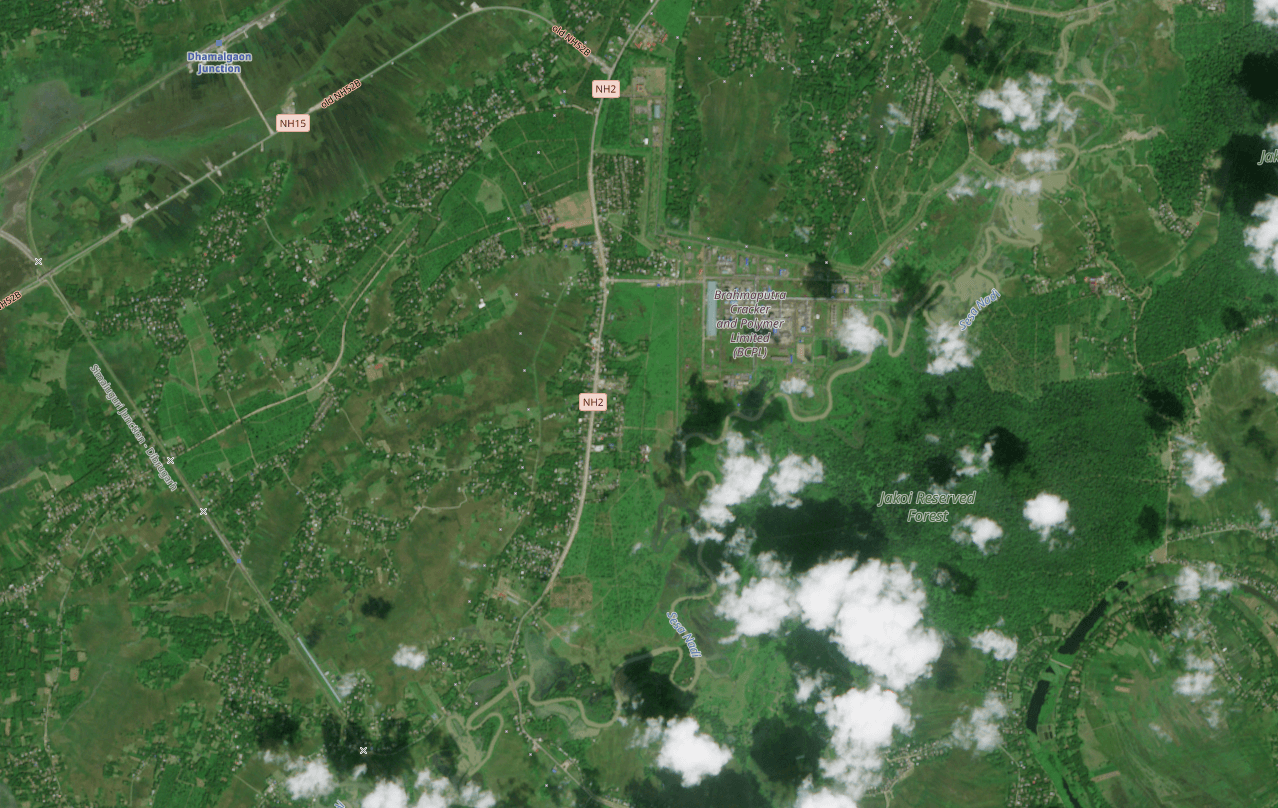
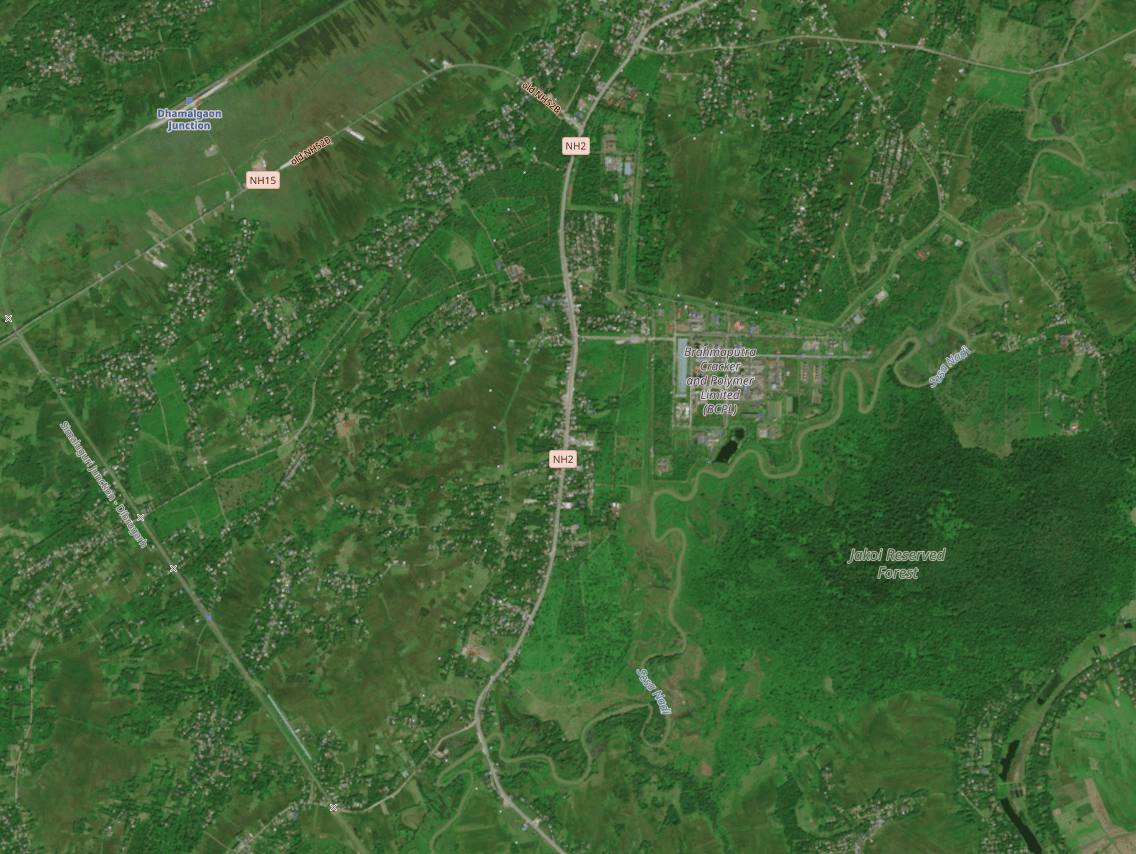
This is the most important finding in the entire case study, and it is the finding that does not appear in the press.
The story it tells is this. Satellite observation, on its own, will hand you false positives. A ten-kilometre buffer around any working tea estate in upper Assam will pick up emissions from whatever else happens to share that geography — a refinery, a coal-fired plant, a paper mill, a petrochemical complex. The buyer who acts on a satellite-only signal without source attribution will damage relationships with suppliers who have done nothing wrong. The buyer who corrects the attribution before acting will not.
This is the structural problem with satellite-only ESG monitoring. We built RondoTrace specifically to solve it.
Suppose your sustainability team had been monitoring Lepetkata through RondoTrace from January 2022 onwards. The four findings above would not have arrived as a single retrospective dossier. They would have arrived in real time, in the order shown below, each one mapped to the regulation that determines what you have to do about it.
Three years of continuous monitoring at Lepetkata, as the team would have received it.
WORKER SAFETY ALERT
CTC machine; inspector suspended.
Primary source: NewsClick (Jul 2022)
CONTEXTUAL NOTE — NOT AN ALERT
24 CH₄ spikes detected. Source attribution: BCPL petrochemical, not tea operator.
No supplier action required.
EUDR DEFORESTATION FINDING
Consistent with Luxmi-announced 300-bigha clearing for tea tourism project.
COMMUNITY CONSENT FINDING
ATTSA + Adivasi students’ protests against project. Disputed union consent.
A worker safety alert in July 2022, with named parties and a regulatory citation, three years before the British Safety Council India review brings further attention to the case. A quiet contextual note through 2022 and 2023 telling your team to ignore the atmospheric anomalies because they belong to a petrochemical neighbour, not to your supplier — the kind of correction that prevents a destroyed relationship over bad data. And then in a single week in January 2025, two paired findings landing together: the EUDR deforestation finding cross-referenced to Luxmi’s own announcement, and the contested community consent surfaced via ATTSA’s protests. By the end of that week, your team holds four findings, in writing, with primary sources attached, and a specific question to put to the supplier.
None of this required a site visit. None required a questionnaire. None required Luxmi to disclose anything they had not already disclosed publicly. The work was done from your office, on a continuous monitoring basis, against a supplier you had previously categorised as low-risk.
Three of the four signals our engine surfaced at Lepetkata are corroborated by independently documented events at the operator within the analysis window. One signal was correctly redirected away from the operator. None of these findings, taken individually, would meet the evidentiary threshold required for a regulator to act. Taken together, they materially change the risk profile of the site.
Now ask the harder question.
Lepetkata is one site. We chose it because it is not famous. There are hundreds of supplier sites in any major European tea programme that fit the same profile — quiet on the standard stack, alive in the local press, visible from orbit. Your current due diligence almost certainly does not see them this way. The Omnibus simplification of CSDDD just narrowed the toolkit by limiting what you can ask of smaller suppliers in the chain. The work still has to be done. The question is how.
This is the gap we built RondoTrace for. Continuous satellite observation, married to a public-record corroboration engine that reads the local press and the regulatory filings the same way a careful human investigator would, and a mapping layer that ties every finding to the specific clause of CSDDD, CSRD, EUDR, ESRS, ILO, IFC PS, or the UN Guiding Principles that a buyer would need to act on.
We would be glad to run the same analysis on a site of your choosing.
Related analysis

Forensic retrospective on any supplier site — including yours. We deliver the methodology, the imagery, the dated observations, and the limitations. Thirty days, no commitment.