 RondoTrace
Independent construction monitoring by satellite for project lenders
Last updated:
In short
Independent construction monitoring by satellite gives a project lender its own record of how fast a financed plant is being built, separate from the borrower's progress reports. RondoTrace measures built area, night-time brightness and first heat at the site, and sets them beside the dates the borrower has announced.
What it is
A lender to a large project normally learns about progress from the borrower and from a technical adviser who visits a few times a year. Satellite construction monitoring adds a measured record that does not pass through the borrower. It follows the outward signs of building: ground being cleared and built on, the site getting brighter at night and, at a plant with furnaces or flares, the first heat.
How it works in practice
We draw the site boundary and measure the built area inside it for each year, using the typical month so that one cloudy month does not distort the figure. We measure brightness at night by month and compare it with a nearby town where that helps. We record signs of heat by month.
We then list the steps that can be seen from orbit, mark each as seen or not yet seen, and place the borrower's public statements on the same timeline. Where we carry the measured pace forward, the line is dotted and labelled as the current pace continued. Our article on checking construction progress from orbit has more on the method.
A worked example: a steelworks at Boden, Sweden
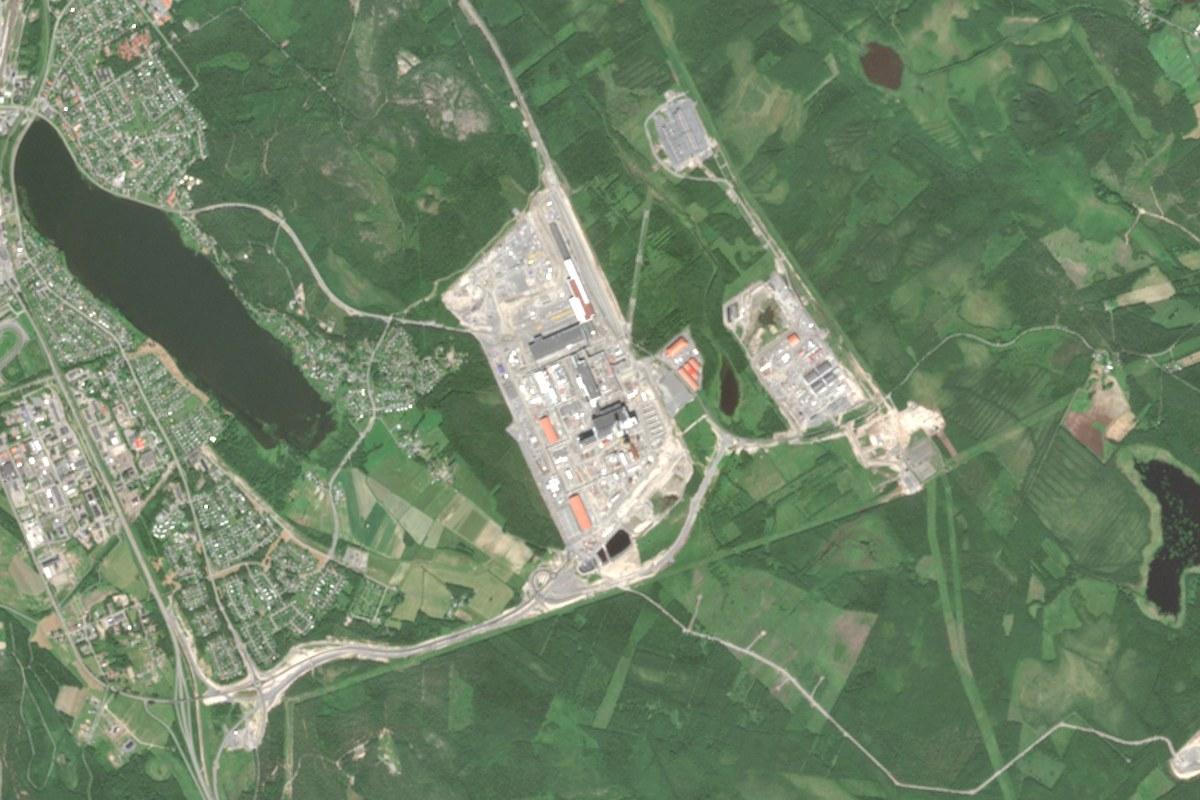
The Stegra steelworks at Boden is in our Outlook tool for lenders. The built area was 133 hectares in 2024, 260 in 2025 and 306 in summer 2026, so building work was still going on. In the months we could measure in 2026 the site was 1.31 times as bright at night as Boden town, against 0.80 times in the same months of 2025.
We saw no sign of heat in any of the 12 months from November 2025 to October 2026, which is why we believe the plant has not started making steel. On 29 October 2026 the company reported that installation of its electric arc furnaces had begun a few weeks earlier.
Limits
Built area shows how much ground has been built on, not how complete a plant is inside. We cannot see equipment being installed under a roof, and we cannot see contracts or the project's finances. Cloud and haze lower confidence at some sites, and we say so. At Boden there is no brightness reading from May to August, because it does not get dark. A projection is the measured pace carried forward and nothing more. We do not predict incidents, and we do not say how likely one is.
Who uses this and for what
- Project finance lenders use it between the technical adviser's visits.
- Lenders' technical advisers use it to prepare a visit and to check reported progress.
- Credit and portfolio teams use it to compare several financed projects on the same measures.
Questions buyers ask
Does this replace the lender's technical adviser?
No. An adviser inspects the works, reads the contracts and judges quality, which cannot be done from orbit. The satellite record covers the months between visits and gives the adviser measured dates to work from.
How do you know a plant has started operating?
For a plant with furnaces or flares, the first sign is heat. At a gas export plant it is usually a flare. Until we see heat we say the plant has not started, and we give the months we looked.
Can you say when the project will be finished?
We can carry the measured building pace forward and show when it would reach a published target, labelled as the current pace continued. That is arithmetic on the record, and it changes if the pace changes. Completion inside the buildings is not visible to us.
Does the borrower need to agree?
No. The measurements are taken from orbit, and the statements we use are public.
You can try this on real sites in the Outlook tool, ask for a first reading of a site of your own at Check a site, or read Which supply chain risks satellite monitoring can detect, and which it cannot.